Acne management
General principles of treatment
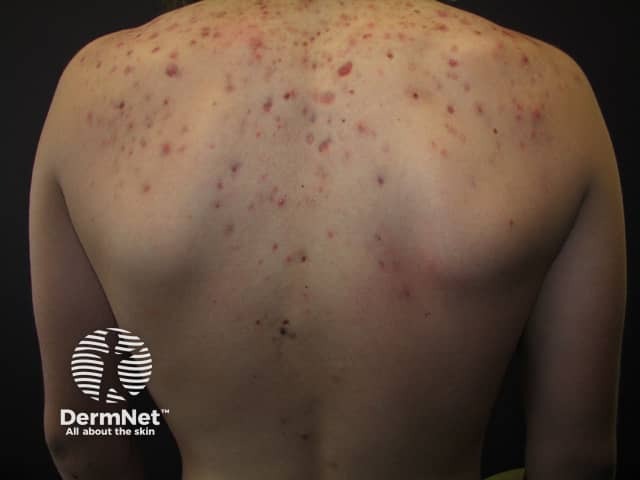
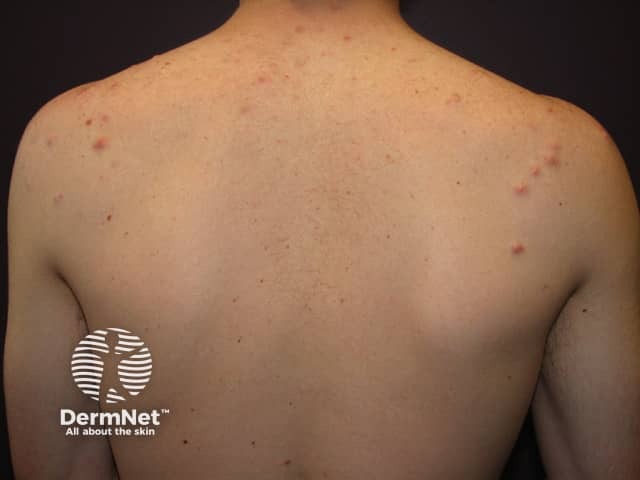
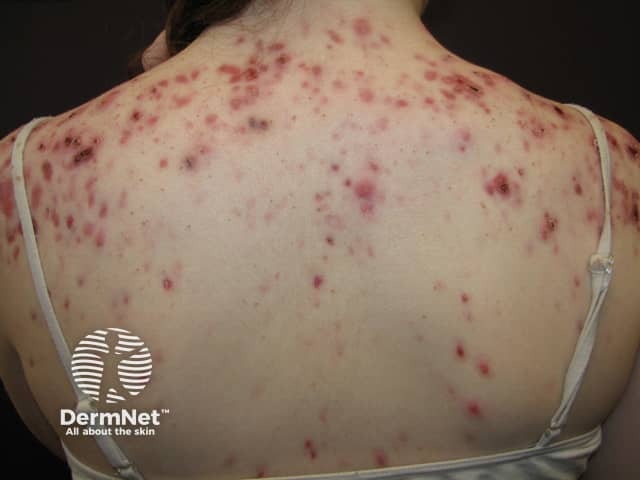
Mild acne
Moderately severe acne
Severe acne
General principles of treatment
- Acne can be effectively treated, although response may sometimes be slow.
- Where possible, avoid excessively humid conditions such as a sauna, working in an unventilated kitchen or tropical vacations (but ultraviolet light helps).
- Try not to apply irritant oils or cosmetics to the affected skin.
- Abrasive skin treatments can aggravate both comedones and inflammatory lesions.
- Try not to scratch or pick the spots
- No relationship between particular foods and acne has been proven.
Management of mild acne
Most patients with mild acne can be treated with topical treatment (gels, solutions and lotions) that can be obtained over-the-counter in New Zealand without prescription. Most people just use topical agents for facial skin as they can be difficult to apply to one's back. Extra vitamins and minerals have not been proved to help.
- Wash affected areas twice daily with a mild cleanser and water or an antiseptic wash.
- Acne products should be applied to all areas affected by acne, rather than just put on individual spots.
- A thin smear should only be applied to dry clean skin at nighttime.
- Acne products may work better if applied in the morning as well.
- They often cause dryness particularly in the first 2-4 weeks of use. This is partly how they work. The skin usually adjusts to this.
- Apply an oil-free moisturizer only if the affected skin is obviously peeling.
- Avoid applying oily cosmetics such as foundation or sunscreen.
- It may take several weeks or even months to see convincing improvement.
- Discontinue using product if severe irritation results. See your doctor for advice.
Suitable topical agents for mild acne that can be obtained without prescription include:
- Antiseptic washes (Acnederm wash™, Benzac™ AC Wash, Dalacin™ T Prewash, Oxy™ Daily Skin Wash)
- Mild salicylic acid preparations to exfoliate and unplug the follicles (Neutrogena® Oil-free Acne Wash and many others)
- Benzoyl peroxide cream / lotion / gel (PanOxyl™ Acne Gel, Brevoxyl™ Cream, Oxy-10™, Clearasil™ Ultra Acne Cream, Benzac AC Gel)
- Azelaic acid (Skinoren™ cream, Acnederm™ medicated lotion)
- Hydrogen peroxide in stabilised cream (Crystacide®)
- Tea tree oil products
Topical agents for mild acne which require prescription include:
- Antibiotics, such as clindamycin solution (Topicil™) or erythromycin solution (Stiemycin™) and gel (Eryacne™) are best used with benzoyl peroxide or azelaic acid to reduce the chance of antibiotic resistance.
- Retinoids i.e. tretinoin (Retin-A™), isotretinoin (Isotrex™), adapalene (Differin™).
Blue light acne treatment is a new procedure recently found to be safe and helpful for mild to moderate acne.
See your doctor or dermatologist for advice if your pimples fail to clear up within six weeks or you have severe acne.
Management of moderately severe acne
Treatment for moderately severe acne usually includes topical agents. In addition, a doctor or dermatologist may prescribe an oral medication, usually for at least six months.
Suitable oral medications include:
- Antibiotics such as tetracycline, minocycline, doxycycline or erythromycin
- In females, oestrogens and antiandrogens such as Diane 35™/Estelle 35™ or spironolactone
- Some patients are helped by nonsteroidal anti-inflammatory agents such as ibuprofen or naproxen
- For resistant or persistent acne, oral isotretinoin may be more suitable
See your doctor or dermatologist for advice if your skin problem fails to improve within three months or you have severe acne.
Management of severe acne
Treatment for severe acne requires oral treatment. Patients should be under the care of a dermatologist.
Many patients will be treated with oral isotretinoin.
If this is not suitable, the following may be used:
- High dose oral antibiotics for six months or longer
- In females, especially those with polycystic ovary syndrome, oral antiandrogens such as oestrogen/cyproterone or spironolactone may be suitable long term. Systemic corticosteroids are sometimes used for their antiandrogenic effect. Flutamide and finasteride also been reported to be of benefit in hyperandrogenic women. At this time, these medicines are registered for treatment of prostatic cancer (and in the case of finasteride, for androgenetic alopecia) in males only, in New Zealand.
Physical treatments for acne
- Sunlight is anti-inflammatory and can help briefly. However, exposure to ultraviolet radiation results in ageing skin and can eventually lead to skin cancer.
- Cryotherapy (freezing treatment) may be useful to control new nodules.
- Intralesional steroid injections can be used to shrink older nodules.
- Comedones can be expressed or removed by cautery or diathermy.
- Microdermabrasion can help mild acne.
- Lasers and other light systems appear helpful for acne. Treatment is often delivered twice weekly for four weeks. The effect may be enhanced by use of a photosensitising agent (photodynamic therapy).
- Note: X-ray treatment is no longer recommended for acne as it may cause skin cancer.
Related information
On DermNet NZ:
- Topical antiacne treatment
- Acne treatment and acne news – from eMaxHealth
Books about skin diseases:
See the DermNet NZ bookstore