What is onchocerciasis?
Onchocerciasis is a chronic and progressive skin, eye, and neurological disease caused by Onchocerca volvulus, a filarial nematode (worm). The eye disease is often called river blindness.
Who gets onchocerciasis?
Over 90% of cases of onchocerciasis occur in 31 countries in sub-Saharan Africa; the remainder are found in Latin America, and Yemen in the Arabian Peninsula. According to the WHO, onchocerciasis has been eradicated from Columbia, Ecuador, Guatemala, and Mexico but persists in the Amazon region of Brazil and Venezuela.
Of the 218 million people who live in endemic areas, at least 18 million are currently infested; 4 million have a skin disease, and 2 million are blind or visually impaired.
Initial infestation may occur in childhood and produce no symptoms for long periods. However the neurological manifestations mainly affect children.
Short-term travellers to endemic areas are at low risk of onchocerciasis, as multiple bites are required for infestation. Travellers who visit endemic areas for extended periods and live or work near blackfly habitats are at greatest risk of infection.
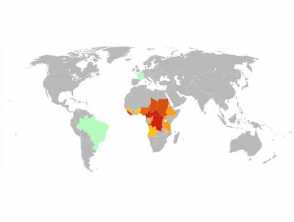
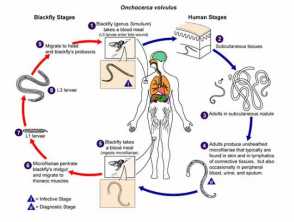
Credit: Onchocerciasis map from Wikimedia
What causes onchocerciasis?
O. volvulus is transmitted to humans through the bite of a female blackfly (Simulium spp). Blackflies are found near fast-flowing rivers and streams in the inter-tropical zones, and bite during the day.
In humans, the adult worms live in nodules scattered under the skin. The female worm produces millions of larval worms (microfilariae). Microfilariae migrate through the lymphatic system under the skin and are ingested by blackflies during a blood meal. The larvae mature in the blackfly over the next two weeks. When the blackfly bites another human, the larvae enter through the wound, penetrate the tissues, and develop into adult worms.
A female worm can live for up to 15 years and produce hundreds of microfilariae each day. The microfilariae mature over 2 to 3 years, and their death releases symbiotic Wolbachia bacteria causing an inflammatory reaction in the skin and eye.
Years of exposure may lead to skin disfiguration and irreversible blindness.
What are the clinical features of onchocerciasis?
Skin disease in onchocerciasis
Six skin disease patterns have been described. Two or more patterns may be present in a single patient, and the patterns may evolve and change over time.
| Classification | Skin features |
|---|---|
| Acute papular onchodermatitis | Widespread itchy eczema-like rash with multiple small itchy papules which progress to become vesicles and pustules. The face, trunk, and extremities are often affected. |
| Chronic papular onchodermatitis | Severely itchy rash with scattered flat-topped papules and areas of hyperpigmentation. The shoulders, buttocks, and extremities are typically affected. The most common pattern of skin disease. |
| Lichenified onchodermatitis | Thickened scaly and hyperpigmented itchy plaques. The lower extremities are commonly affected, and lymph nodes are often enlarged. |
| Onchocercal atrophy | Large areas of wrinkled thin, dry inelastic skin. Commonly affects buttocks and lower back. |
| Onchocercal depigmentation | Also called “leopard skin”. Areas of pigment loss (leukoderma), with islands of normally pigmented skin surrounding hair follicles. Often affects the shins in a symmetrical pattern and is not usually itchy. |
| Palpable onchocercal nodules (oncocercoma) | Subcutaneous lumps found over bony prominences contain the adult worms. The subcutaneous nodules range in size from a few millimetres to several centimetres, and each contains 2 to 4 adult worms that can reach a length of 80 cm. |
Other classic clinical presentations of onchocerciasis include:
- 'Lizard skin' – dry, scaly skin resembling ichthyosis
- 'Hanging groin' – folds of inelastic atrophic skin in the groin associated with enlarged lymph nodes.
Cutaneous onchocerciasis
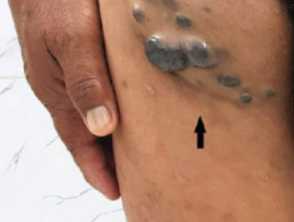
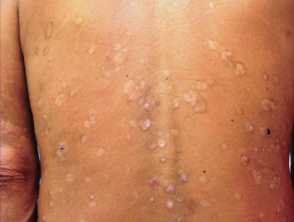
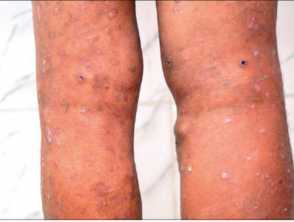
Images from: Pasha MM, Patil CC, Tanuja M, Mitra D. A rare case of cutaneous onchocerciasis in north-east India, review of literature. Indian Dermatol Online J. 2020;11(4):600-3.
Eye disease in onchocerciasis
Inflammation and bleeding in an eye occurs when microfilariae in the cornea and/or back of the eye die. Early symptoms include itching, redness, pain, and photophobia. Repeated episodes of inflammation in the cornea cause a chronic keratitis and sclerosis affecting the clarity of the cornea. Blurring of vision, night blindness, glaucoma, visual field loss, and eventually blindness may develop in the affected eye.
Neurological disease in onchocerciasis
- Nakalanga syndrome
- Nodding syndrome
- Epilepsy
What are the complications of onchocerciasis?
- Psychosocial effects
- Inability to work
- Significant disability due to blindness and neurological effects
How is onchocerciasis diagnosed?
- Identifying microfilariae in six skin snips dropped into normal saline and examined microscopically. In early or mild disease when larvae are not seen, polymerase chain reaction (PCR) is used to amplify the larval DNA.
- Adult worms are seen in excised nodules under a light microscope.
- Microfilariae may be directly observed during slit lamp examination of the eye.
- Detection of antibodies against O. volvulus in blood samples – however, this test cannot reliably distinguish between past and present infection so is used for diagnosing patients with a brief exposure history.
How is onchocerciasis treated?
Prevention
- No vaccine available
- Vector control using DDT or temephos to eliminate blackflies
- Mass ivermectin dosing every six months to interrupt the worm life cycle
- Prevent blackfly bites
- Use of insect repellents such as DEET
- Wearing long-sleeved shirts and pants
- Wear permethrin-impregnated clothing
Systemic treatment
- Oral ivermectin kills the microfilariae but not the adult worm. One dose every 3 months is required.
- Doxycycline targets the Wolbachia bacteria and is used in combination with ivermectin.
- New agents under investigation to kill the adult worm include suramin and moxidectin.
What is the outlook for onchocerciasis?
Onchocerciasis has been successfully eradicated from some countries and programmes continue in many others. Treatment of established infestation is not curative, but aims to stop progression of disease. Prevention is the most cost-effective measure.