Introduction
Subtypes
Cause
Demographics
After a tick bite
Clinical features
Erythema migrans
Diagnosis
Treatment
Prevention
Lyme disease is an infection caused by Borrelia, a type of bacteria called a spirochaete. Lyme disease can affect any part of the body, most commonly the skin, central nervous system, joints, heart, and rarely the eyes and liver.
Lyme disease is common in parts of the United States (particularly in Massachusetts) and Europe but is reported from many areas of the world. In New Zealand and Australia, cases have only been confirmed in people that have recently travelled from an endemic area.
Lyme disease is also called Lyme borreliosis.
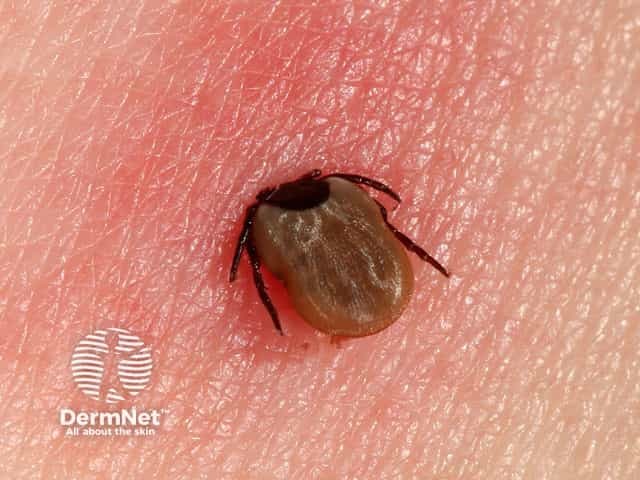
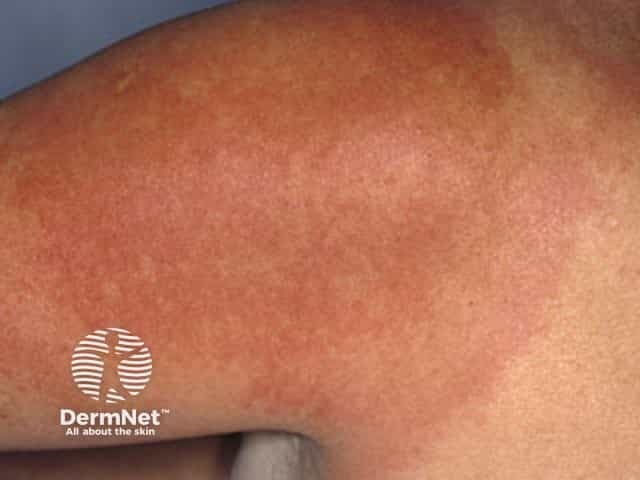
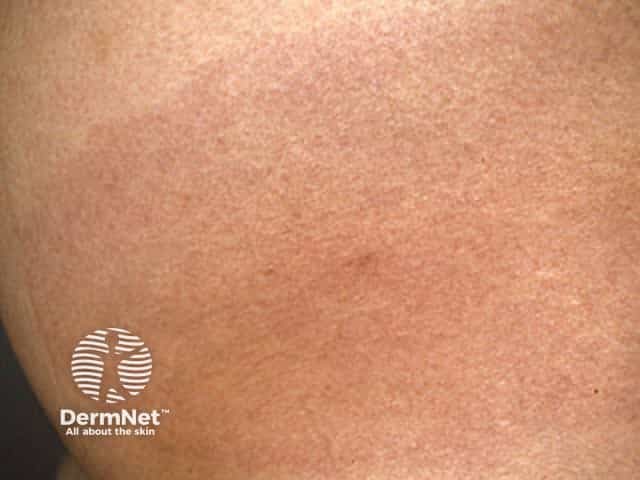
See more images of erythema migrans.
There are different types of Borrelia in each continent resulting in various forms of Lyme disease in North America and Europe.
In North America, the infection is due to the subspecies B. burgdorferi sensu stricto and most often presents as:
In Europe, Lyme disease is due to the subspecies B. burgdorferi sensu stricto, B. afzelii and B. garinii, and most often presents as:
Humans and animals are infected with the bacteria through hard-tick bites. The borrelia survive in the midgut of the ticks. The immature nymphs are most likely to transmit the infection. The ticks feed on infected animals and then on humans.
Ticks occur in high grass, brush, woodland and leafy forest. The main hosts for the ticks and borrelia are small to medium-sized animals in Europe and deer in North America.
Lyme disease can affect children and adults. Infection most often occurs in forestry workers and in those who have been enjoying recreational activities in areas where ticks reside.
Ticks can attach and feed in any part of the human body. The bite is painless. Because they are very tiny (just 2 mm in size) nymph bites are often overlooked. Borrelia are transmitted from the midgut of the infected tick to the attached skin when attachment lasts for 36–48 hours.
Several things can happen after being bitten by an infected tick.
The disease can be divided into three stages according to the extent of the infection.
Stage |
Features |
|
|---|---|---|
Localised Lyme disease |
|
|
Early disseminated Lyme disease |
|
|
Late Lyme disease |
|
|
Erythema migrans, a red expanding patch of skin, is the most typical sign of Lyme disease and is present in 70–80% of cases. It usually appears 7–14 days (range 3–33 days) after the infected tick bite. It starts at the site of the tick bite as a red papule or macule that gradually expands. The size of the rash can reach several dozens of centimetres in diameter. A central spot surrounded by clear skin that is in turn ringed by an expanding red rash (like a bull's-eye) is the most typical appearance. Erythema migrans may also present as a uniform erythematous patch or red patch with central hardening and blistering. The redness can vary from pink to very intensive purple.
Erythema migrans is mostly asymptomatic, but can be itchy, sensitive or warm if touched. It is rarely painful. Fatigue, chills, headache, low-grade fever, muscle and joint pain, may occur briefly and then recur if the disease progresses. Lymph glands near the tick bite may be swollen.
Erythema migrans disappears spontaneouslly within 3–4 weeks. If left untreated the disease may disseminate, affect other organs, and progress to the next stage.
Early diagnosis of Lyme disease is essential. Diagnosis can be made on the presence of erythema migrans and other symptoms, plus a history of or evidence of a tick bite. Laboratory tests are usually not necessary in the early stage of erythema migrans,
Undetected or ignored early symptoms may be followed by more severe symptoms weeks, months or even years after the initial infection. Certain laboratory tests are then recommended to confirm the diagnosis and should be interpreted by an expert..
Positive antibodies to B. burgdorferi can be in many cases detected for many years after the successful treatment.
Tick bites may transmit other infections like tick-born encephalitis, anaplasmosis and babesiosis. Co-infections should be considered if symptoms of Lyme disease are severe or prolonged, in case of high fever, and abnormal blood tests results (leucopenia, thrombocytopenia, or elevation of liver transaminases).
Localised or early Lyme disease generally responds well to appropriate antibiotics. Full cure is usually achieved if the disease is diagnosed and treated promptly, but the cure rate decreases the longer treatment is delayed. The choice of antibiotic depends on bacterial sensitivity.
Antibiotics used for erythema migrans include doxycycline, amoxicillin and cefuroxime. Secondline treatments are the macrolides, azithromycin and erythromycin. Intravenous penicillin and cetriaxone are used for more advanced Lyme disease. The route of administration and the duration of the course of antibiotics depends on the stage and organ involvement. It varies between 10 and 30 days. Late stage Lyme disease, especially neuroborreliosis, should be treated with intravenous antibiotics.
Some patients have persistent or recurrent symptoms of unknown origin after apparently successful antibiotic treatment for Lyme disease. This is called post-treatment Lyme borreliosis syndrome. It is believed to be an auto-immune response. Prolonged antibiotic treatment does not improve cure rates.
There is no vaccine for Lyme disease.