Introduction
Skin reactions
Diagnosis
Treatment
Prevention
Alternative names
Further information
Isothiazolinone mix includes the compounds 2-methyl-4-isothiazolin-3-one and 5-chloro-2-methyl-4-isothiazolin-3-one. They are used together as a preservative in cosmetics and commercial household products such as shampoos, cleaners and washing materials. It also has wide industrial uses. Isothiazolinone mix is more commonly known as the preservative product with the commercial name Kathon.
Testing should also include methylisothiazolinone (MI), a related allergen that has caused an epidemic of contact allergic dermatitis in people using moist wipes and other products containing MI.
Products commonly containing isothiazolinone mix |
||
Cosmetics |
Pharmaceutical/self-hygiene products |
Household/industrial products |
|
|
|
Alternative products are usually available. For example, Persil Sensitive® liquid laundry contains Kathon CG (isothiazolinone) but Persil Sensitive® Powder does not.
Localised allergic contact dermatitis may occur in sensitive individuals. The risk of sensitization is greater when the skin barrier is damaged, e.g when eczema is already present. A sensitivity reaction is also dependent on how contact with the product occurs and the concentration of isothiazolinone mix present. Preservatives with high corrosive concentrations of isothiazolinone mix may cause chemical burns in sensitized individuals.

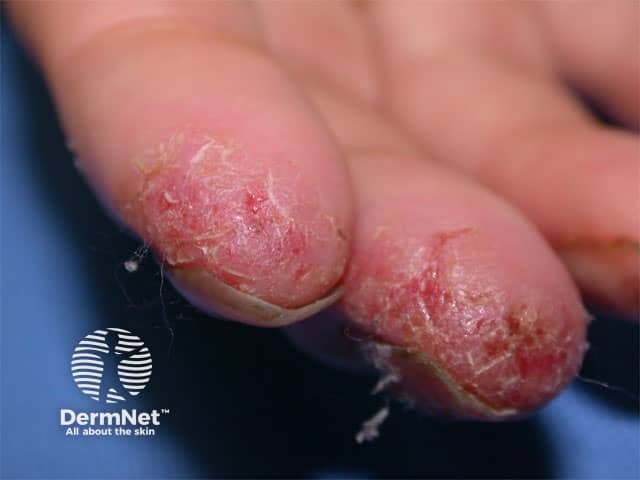
Isothiazolinone mix allergy is diagnosed from the clinical history and by performing special allergy tests, i.e. patch tests, using a solution of isothiazolinone mix 0.01–0.02% in aqueous solution.
Self-testing a product for isothiazolinone mix is possible but should be done only after first talking with your dermatologist. This should be done only with products that are designed to stay on the skin such as cosmetics (not including eyeliners or mascaras) and lotions. Apply a small amount of the product to a small tender area of skin such as the bend of your arm twice a day for one week. Examine the area each day and if no reaction occurs, the product is most probably suitable for you to use. Even so, you should still be cautious if you are intending to use it over large areas. Products such as shampoos, soaps and cleansers should not be tested in this way as they may cause an irritant dermatitis on tender areas of skin, which is not an allergic reaction.
See also methylisothiazolinone.
If you are diagnosed with isothiazolinone mix allergy then avoid exposure to isothiazolinone mix-containing products.
Once the dermatitis appears on the skin, treatment is as for any acute dermatitis/eczema, i.e. topical corticosteroids (those not containing isothiazolinone preservatives), emollients, treatment of any secondary bacterial infection (Staphylococcus aureus), etc.
Once isothiazolinone mix sensitivity is confirmed you should try to avoid exposure to any products containing isothiazolinone mix. Read product labels and avoid products that contain isothiazolinone mix or any of its alternative names. If unsure, ask your pharmacist for advice or a suitable alternative.
Inform your employer about your allergy. In the workplace try to avoid exposure to isothiazolinone mix, however if this is not practicable use measures such as protecting your skin with gloves to minimize exposure. Identify potential sources of exposure using Material Safety Data Sheets; these are required for all chemicals and substances that you may come into contact with in the workplace.
Alert your doctor to the fact that you have an allergy to isothiazolinone mix. Your dermatologist may have further specific advice, particularly if you are highly sensitive.
Methylisothiazolinone (MI), a related allergen, was declared the Contact Allergen of the Year for 2013 by the American Contact Dermatitis Society (ACDS). Allergy to MI can be missed by only testing to isothiazolinone mix.
CAS number
Sensitiser
Patch Test: