Created 2008.
Dermatitis and eczema are words that are often used interchangeably to describe a variety of distinct skin conditions in which there is epidermal and dermal inflammation and nearly always intense itching.
It is useful to distinguish ‘acute’, ‘subacute’ and ‘chronic’ forms of eczema.
Acute dermatitis is characterised by erythema, vesiculation and oozing, often with oedema.
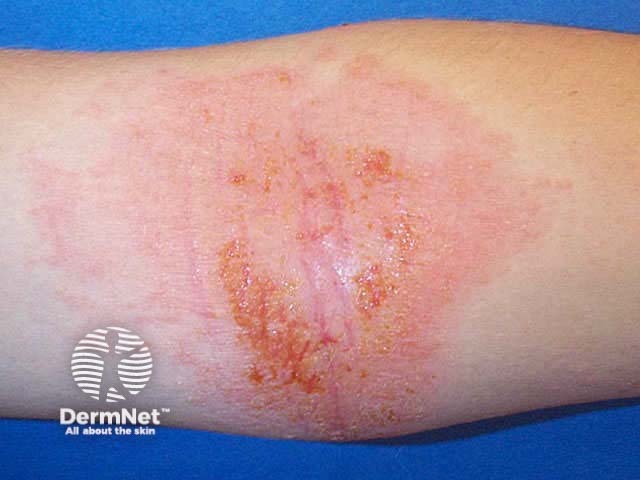


Subacute dermatitis is similar to acute dermatitis, but with scaling and crusting.


Chronic dermatitis is characterised by thickened dry patches, often lichenified from chronic rubbing (increased skin markings). Lichenification is often predominantly follicular in pigmented skin.


Lichen simplex chronicus describes localised patches of lichenification because of rubbing and scratching; the patches become increasingly itchy so it is difficult to stop scratching. It may be a complication of atopic dermatitis. Well-defined papules and bumpy thickened plaques are found most often in adults on the nape of the neck, occipital scalp, lower legs, forearms, vulva or scrotum. Widespread lichen simplex is often called neurodermatitis.


Prurigo refers to skin lesions (papules or nodules) that itch intensely. It includes:


Autosensitisation dermatitis is the rash that appears on the trunk and limbs due to generalisation of a previously localised condition such as asteatotic or venous eczema. It may appear similar to nummular dermatitis and can be intensely pruritic, requiring systemic steroids for control. An id reaction is autosensitisation dermatitis arising in response to a fungal infection.
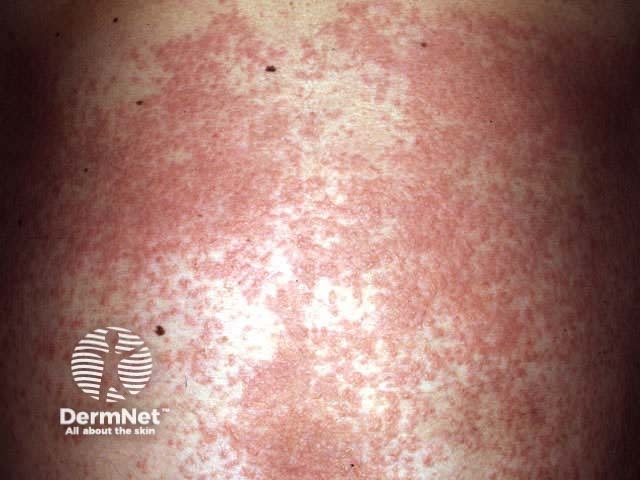
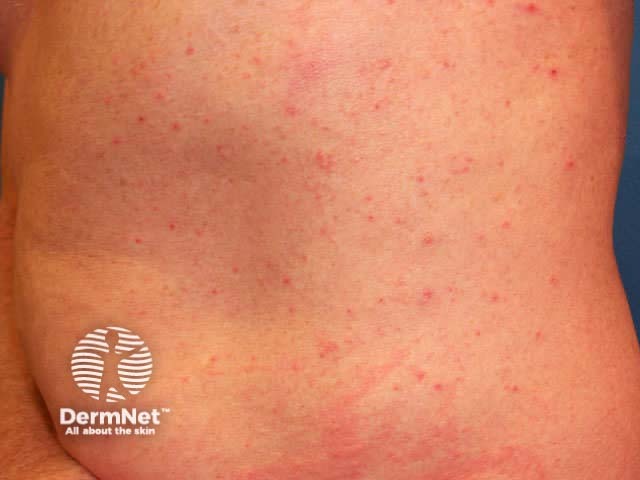

Histologically, dermatitis is characterised by inflammation of the epidermis and epidermis i.e perivascular lymphohistocytic infiltrate. The hallmark of acute dermatitis is spongiosis (intraepidermal vesicles). As eczema becomes more chronic, there is tendency for it to become more acanthotic (thickened epidermis) and less spongiotic.


Management of dermatitis involves:
When is scratching just a bad habit, and can it be avoided?
Information for patients
See the DermNet bookstore