Created 2008.
Examination of the hair and scalp, axillary and pubic hair and body hair is part of a full skin examination. Evaluate hair quantity and quality i.e. its length, density, colour and texture. Is it straight, wavy or curly? Look for associated skin conditions, especially those affecting the scalp.


Hair loss associated with excessive shedding results in a positive “gentle hair pull” test. Grasp a lock of hairs to determine if any can be extracted with firm pull. Normally 0-2 telogen hairs can be extracted: these are hairs in the resting phase, identified using magnification by a rounded bulb at the proximal end. An elongated or tapered end indicates anagen hair (growing phase); anagen hairs extracted by the gentle hair pull test are pathologic.
Thinning hair or balding (alopecia) may be localised or diffuse.
Localised alopecia may affect a single or multiple areas. Inspection may reveal:


Diffuse alopecia is most often due to pattern balding, and more prominent over the vertex of the scalp. In males there is often frontal recession. Shedding is usually normal or mildly increased in pattern balding. The hair shaft is thinned.
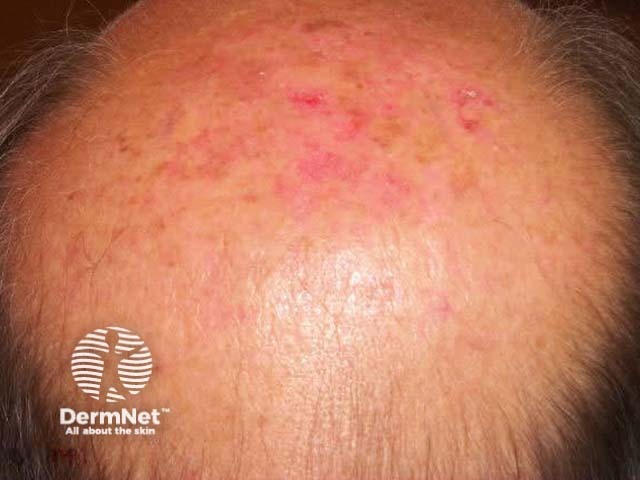


Generalised diffuse alopecia is more likely to be associated with excessive shedding. A hair pull test may reveal numerous telogen and/or anagen hairs (telogen or anagen effluvium respectively).

Rare genetic hair shaft abnormalities identified on microscopy are beyond the scope of this article.
Evaluate the appearance of the scalp, whether it is generally excessively oily or dry. Look for localised lesions and inflammatory skin diseases.
Evaluate:


A complete examination should include inspection of terminal hair of the eyebrows, eyelashes, beard, axilla and pubic area as well as body hair generally.
In adolescents where relevant, note stage of pubertal development using Tanner growth charts. Premature pubarche refers to appearance of pubic hair without other signs of puberty before age 9 years in boys, before age 7 years in white girls and before age 6 years in black girls.
Excessive hair may be due to localised or diffuse hypertrichosis or in women, hirsutism, which refers to an adult male pattern of hair growth.
Hypertrichosis describes localised or diffuse excessive hair on face, arms, legs or trunk. It may be due to increase in lanugo (soft, fine and blond) or terminal hair.
To assess hirsutism, evaluate presence and severity of terminal hair on the face in the beard areas and the lower abdomen. A diamond pattern for escutcheon indicates hirsutism, as the usual female pattern is a triangle. Hirsutism may also affect chest and back.
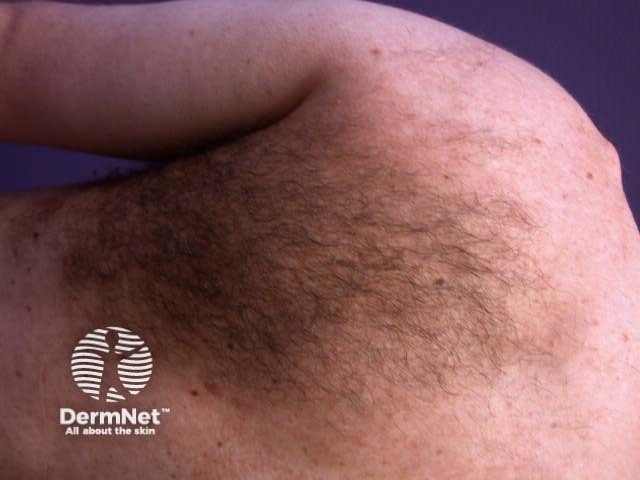
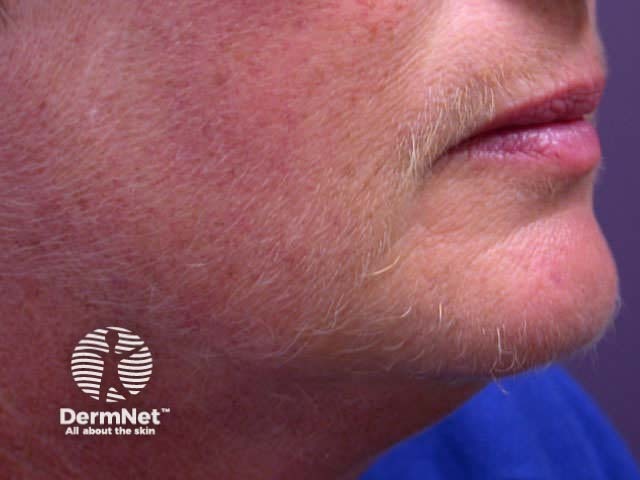
Describe racial variations in hair colour, morphology, quantity and distribution.





 Previous Chapter