Psoriasis overview
Learning objectives
Introduction
Histology of psoriasis
Clinical features of psoriasis
PASI score
Activity
Learning objectives
- Describe the pathogenesis and histology of psoriasis
- Outline clinical presentations of psoriasis and their differential diagnosis
- List options for treatment
Introduction
If an adult or child presents with an acquired predominantly scaly eruption, the most likely explanation is psoriasis, which is estimated to affect 1-4% of the population. Itching may be absent, but tends to be mild to moderate. Psoriasis is a chronic dermatosis of genetic origin, often precipitated by an event such as an infection, an injury or psychological stress. It is associated with inflammatory arthropathy.
Genetic predisposition
There appear to be at least seven psoriasis susceptibility genes. Abnormal expression of one or more of these leads to infiltration of psoriatic plaques by Th1 or cytotoxic lymphocytes and subsequent overproduction of certain pro-inflammatory cytokines, particularly tumour necrosis factor alpha (TNF-α), interferon gamma (IFN-γ), interleukins 2 & 12.
The cytokines stimulate keratinocyte proliferation. Epidermal cells take about a week instead of the normal month or two to transit through the skin, with an increased number of actively dividing cells and an increased rate of reproduction. This is a similar pattern to healing wounds.
Precipitating causes
Although there is often no obvious cause, the following may induce or aggravate psoriasis:
- Physical and emotional stress
-
Infections
- Streptococcal tonsillitis – guttate psoriasis
- Candida – flexural psoriasis
- Malassezia – scalp psoriasis
- Physical, chemical, electrical, infective and inflammatory injury (Koebner phenomenon)
- Hormones: post-pubertal onset is common; pregnancy may improve or worsen
-
Medications: withdrawal of the responsible drug may lead to improvement but does not always do so
- Lithium
- Interleukin II
- Interferon
- Beta blockers
- Anti-malarials
- NSAIDs (uncommon)
- Withdrawal from corticosteroids
- Ultraviolet radiation
- Excessive alcohol
- Smoking
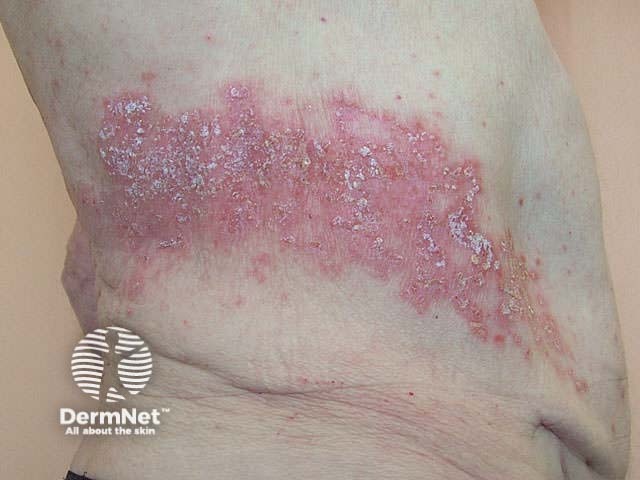
Characteristics of psoriatic plaque
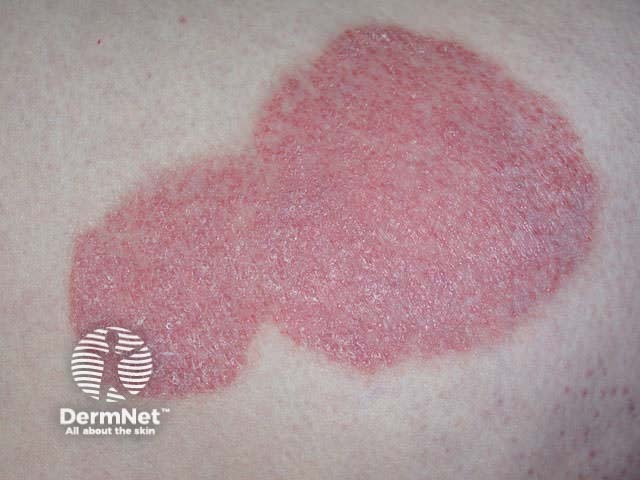
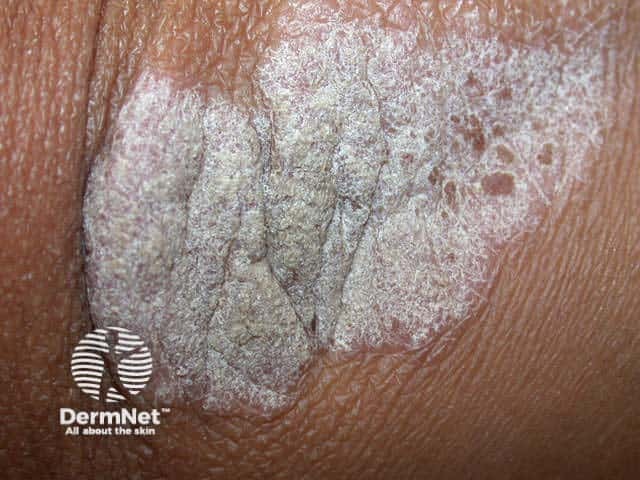
- Symmetrical distribution in typical sites
- Well-demarcated borders
- Pink to red colour
- Plate-like scale that is easy to peel off
- Bleeds easily e.g. on scratching
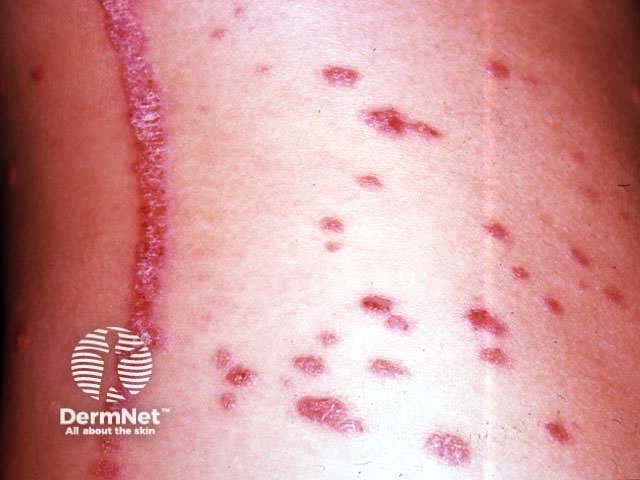
- Linear plaques at sites of skin trauma (Koebner phenomenon)
|
|
|
PASI score
The PASI score (Psoriasis Area and Severity Index) is used to evaluate severity in plaque-type psoriasis, and ranges from 0 to 72. The PASI evaluates the degree of erythema, thickness, and scaling of psoriatic plaques, and estimates the extent of involvement of each of these components in four separate body areas (head, trunk, upper and lower extremities). In general terms, PASI >12 defines severe, PASI 7-12 moderate and PASI <7 mild chronic plaque-type psoriasis.
The PASI score is imprecise and there have been various attempts to improve on it. However, it remains the most commonly used assessment of the effectiveness of treatment by its ability to result in 75% or, more realistically, 50% reductions in PASI score at certain timepoints.
Histology of psoriasis
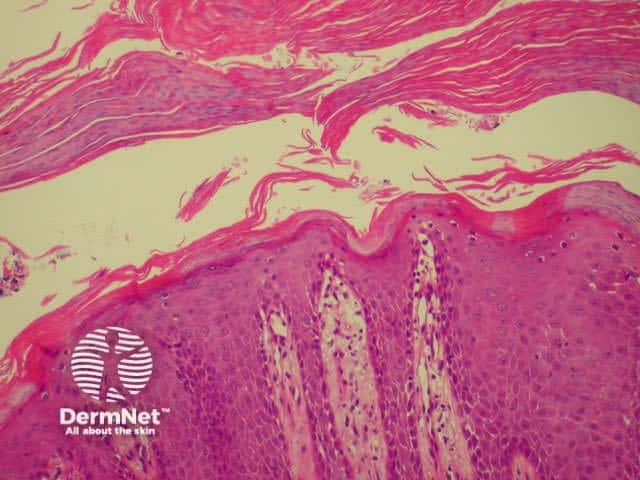
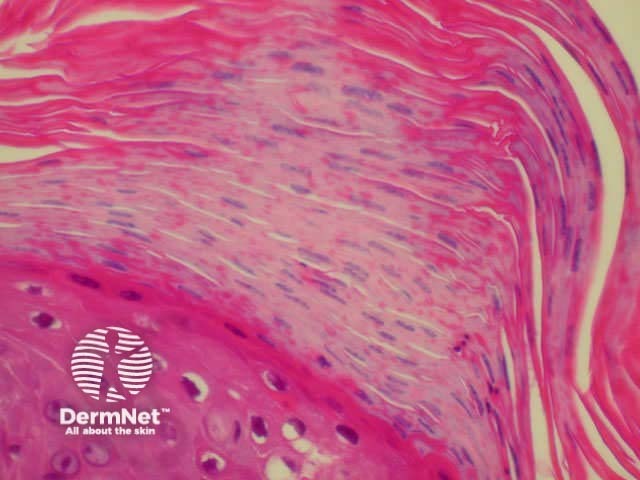
Histology of psoriasis is characterised by parakeratosis (cell nuclei within stratum corneum) and thickened projections of the prickle cell layer of keratinocytes (psoriasiform hyperplasia). There is no granular layer. Polymorphonuclear leukocytes and lymphocytes infiltrate dermis (CD8+) and epidermis (CD4+).
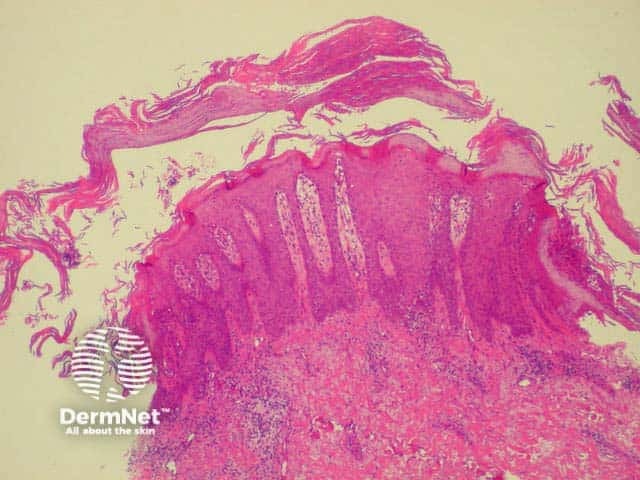
Thick stratum corneum and projections of epidermis |
Note inflammatory infiltrate |
Parakeratosis (cell nuclei within thickened stratum corneum) |
Clinical features of psoriasis
The skin disease may present as one or other form of acute psoriasis, chronic psoriasis or localised to hands and feet. These subtypes may overlap. Types of psoriasis include:
- Acute guttate psoriasis
- Chronic plaque psoriasis
- Scalp psoriasis
- Palmoplantar psoriasis
- Flexural psoriasis
- Generalised pustular psoriasis
- Psoriatic arthropathy
- Nail psoriasis
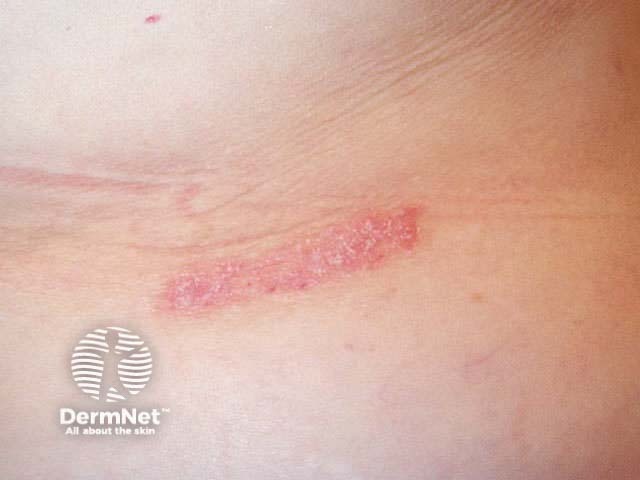
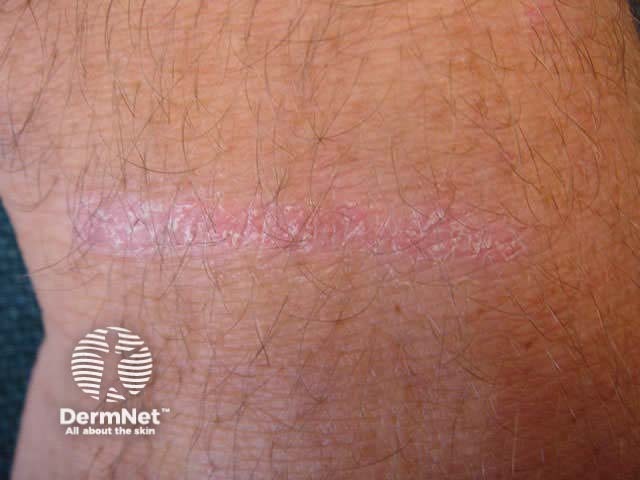
Koebner phenomenon
- Psoriatic plaques may develop at the sites of skin trauma, including scratches, sunburn, tight clothing, surgery
- The healing skin in those genetically predisposed triggers excessive keratinocytes proliferation
- Koebnerised lesions are frequently linear in shape
|
|
|
|
Psoriatic arthropathy
- Several distinct forms including spondyloarthropathy, arthritis mutilans, oligoarthropathy and a rheumatoid-like pattern
- All forms of psoriatic arthritis are rare in children.
- Although more common in those with severe psoriasis, it may develop in those with mild psoriasis and may flare independently of the skin disease
- Systemic treatment with immunomodulating drugs such as methotrexate, ciclosporin, etanercept and infliximab may improve both skin and joint manifestations
PASI score
The PASI score is the ‘Psoriasis Area and Severity Index’, and is mainly used for evaluating the effect of interventions in clinical trials. It is calculated as follows:
Differential diagnosis
Plaque psoriasis may be confused with:
- Discoid dermatitis (more itch, vesicles, dry rather than plate-scale)
- Tinea corporis (elevated border, slowly extending edge, positive mycology)
- Pityriasis rosea (herald patch, fir-tree distribution of oval plaques, trailing scale, duration less than 3 months)
- Seborrhoeic dermatitis (thin, paler patches with smaller flakes of scale on scalp, face and sometimes upper trunk)
- Psoriasiform drug eruption (unusual features, clears with drug withdrawal)
- Pityriasis rubra pilaris (cephalo-caudal spread, follicular prominence)
Generalised pustular psoriasis may be confused with:
- Acute generalised exanthematic pustulosis (drug eruption that settles with withdrawal of drug)
- Bacteraemia and bacterid: cutaneous pustules arising during gram positive and gram negative septicaemia
- Infected generalized atopic and/or seborrheic dermatitis
- Pityriasis rubra pilaris
- Reiter syndrome
- Folliculitis
Investigations
In most cases of psoriasis, no specific investigations are required. However, on occasion the following may be useful:
- Skin swabs for bacteriology: to identify secondary infection (Staph. aureus and Strept. pyogenes)
- Throat swab for beta haemolytic streptococcus
- Skin scrapings and nail clippings to rule out dermatophyte infection
- Skin biopsy to confirm diagnosis
- Blood count, electrolytes, calcium, liver function in acutely unwell patients
Management
It is most important to explain the nature of psoriasis to the patient presenting with psoriasis for the first time. Provide them with written material and refer them to DermNet (http://www.dermnetnz.org/) for further information. They need to be aware that there is no known cure and that psoriasis may persist lifelong. Treatment rarely results in complete clearance but reduces the severity and extent of the disease.
Topical agents include:
- Calcipotriol
- Corticosteroids
- Emollients
- Coal tar
- Keratolytics such as salicylic acid
- Dithranol
Phototherapy may include:
- Broadband or narrowband ultraviolet B (short wavelength UVB)
- Photochemotherapy (psoralens and ultraviolet, usually long wavelength UVA)
- Excimer laser for localised plaques
Systemic agents include:
- Methotrexate
- Ciclosporin
- Acitretin
- Hydroxyurea
Oral corticosteroids are nearly always contraindicated.
Activity
Describe the impact of psoriasis on daily living activities and occupation.
Page 2 of 9. Next topic: Acute forms of psoriasis. Back to: Scaly skin diseases course contents.
Related information
References:
On DermNet NZ:
Information for patients
Other websites:
- Emedicine: Psoriasis
-
Medscape:
- Quality of Life Considerations in Psoriasis Treatment from Dermatology Nursing 2003
- Treating Psoriasis: The Dermatologist's Perspective CME presentation July 2005
- Merck Manual Professional: Psoriasis and scaling disorders
Books about skin diseases:
See the DermNet NZ bookstore