Introduction
Demographics
Causes
Clinical features
Variation in skin types
Complications
Diagnosis
Differential diagnoses
Treatment
Outcome
Generalised eruptive keratoacanthoma of Grzybowski, also known as Grzybowski syndrome, is a rare variant of keratoacanthoma characterised by the presence of hundreds to thousands of keratoacanthoma-like papules scattered on the skin and mucous membranes.

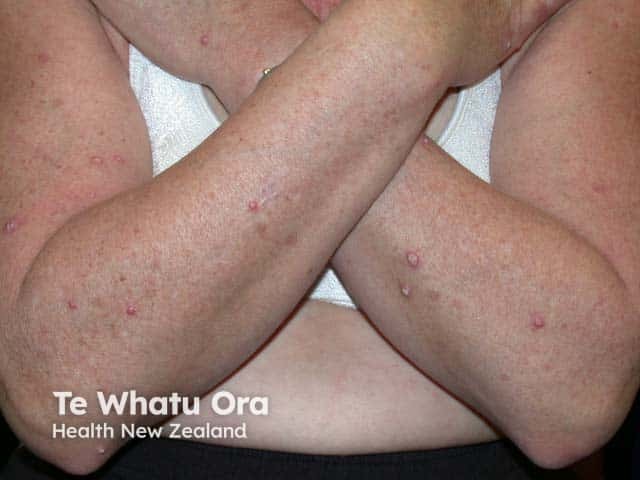

Generalised eruptive keratoacanthoma is a very rare disease. It was first described in 1950 and around 40 cases have been reported since.
The cause of generalised eruptive keratoacanthomas is not completely understood but they have been associated with:
Generalised eruptive keratoacanthomas present as a sudden or progressive eruption of hundreds to thousands of small (1–5mm), pruritic, umbilicated, skin-coloured to erythematous papules, with a central keratotic plug.
They predominantly affect sun-exposed areas, such as the face and upper trunk, but also have a particular predilection for the intertriginous areas and may be seen on the tongue, the buccal mucosa, and the larynx.
Lesions on the face may be extensive. Confluent periorbital keratoacanthomas may produce a mask-like appearance, known as the sign of Zorro.


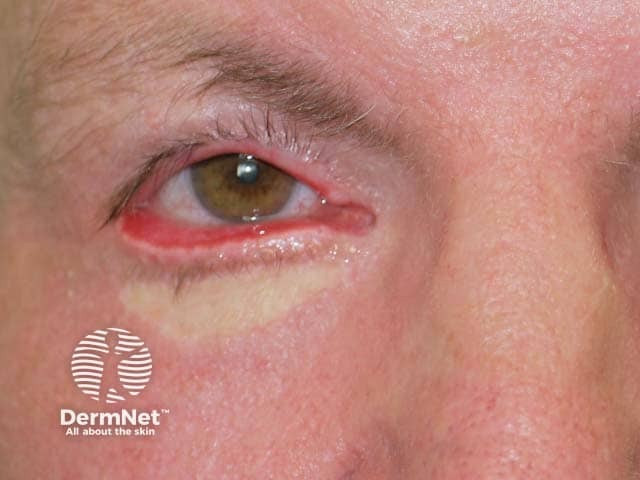
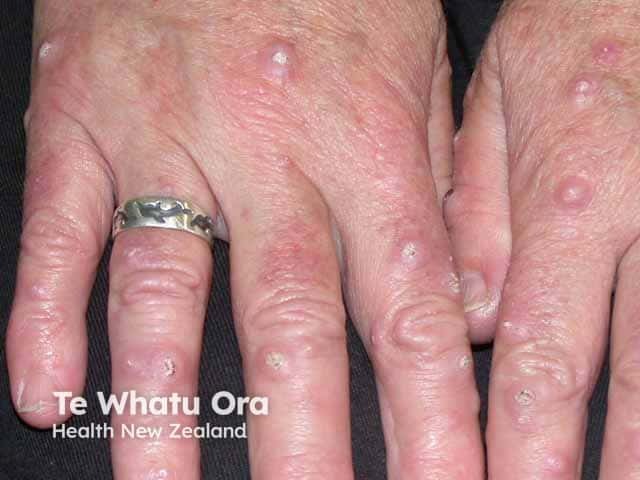
Generalised eruptive keratoacanthomas have been described in patients of all skin phototypes.
Generalised eruptive keratoacanthoma is a chronic, progressive disease associated with significant morbidity:
The diagnosis is established based on the clinical features and typical histology showing a crater-shaped squamoproliferative lesion with atypical keratinocytes with a central keratin plug similar to a solitary keratoacanthoma.
Treatment for generalised eruptive keratoacanthoma is unsatisfactory. The number, extent, and location of the tumours render treatment difficult.
The most effective and most practical treatment may be oral acitretin.
Treatments that may be considered include:
Oral acitretin
Surgical excision and physical destruction (although often impractical due to the sheer number of lesions and risk of Koebnerisation)
Topical therapy:
Intralesional therapy:
Other systemic therapies:
Generalised eruptive keratoacanthomas are frequently progressive and chronic. Treatment is often unsatisfactory. Malignant change has not been reported.