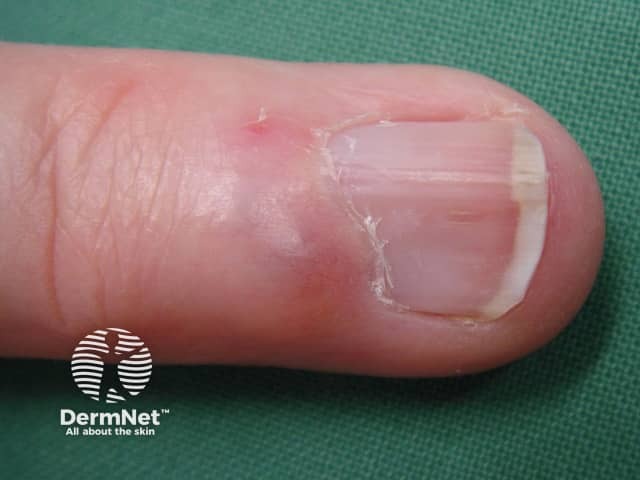
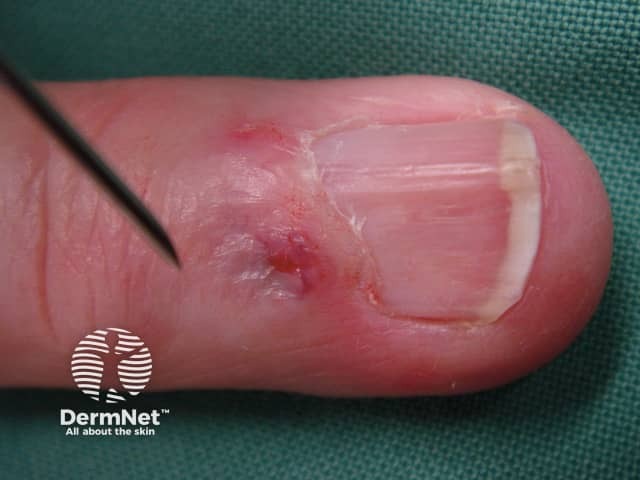
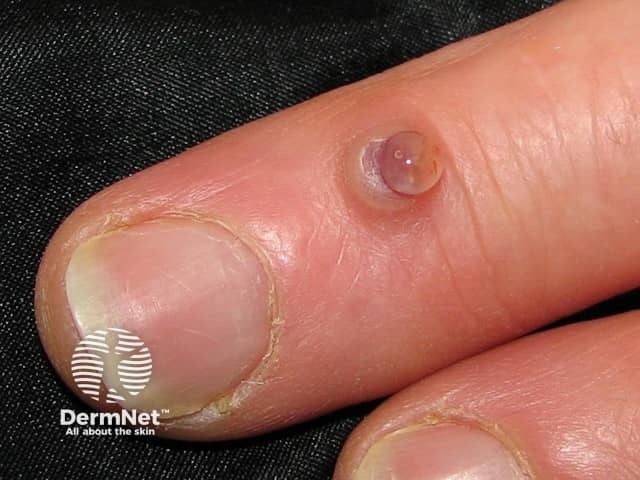
A digital myxoid pseudocyst is a shiny papule found at the end of a finger or toe, close to the nail. It is called a pseudocyst because it is not surrounded by a capsule, unlike a true cyst. It is also called a myxoid cyst, a mucous cyst, a digital ganglion cyst, and a digital synovial cyst.
The cyst arises from degeneration in the connective tissue on the top of the last segment of the finger.
There appear to be two variations. The first is a form of focal mucinosis, a condition characterised by abnormal deposits of mucopolysaccharides (mucins) in the skin. The other variation arises from extension of the lining of the finger joint and is due to osteoarthritis – a type of ganglion. See pathology of a digital myxoid pseudocyst.
The digital pseudocyst is semi-translucent, with a smooth shiny surface. It is most often located within a centimetre of the base of the nail. It often causes a groove in the nail. This may be up to several millimetres across and extends the length of the nail.
Jelly-like sticky fluid may be expressed from the pseudocyst (sometimes tinged with blood).
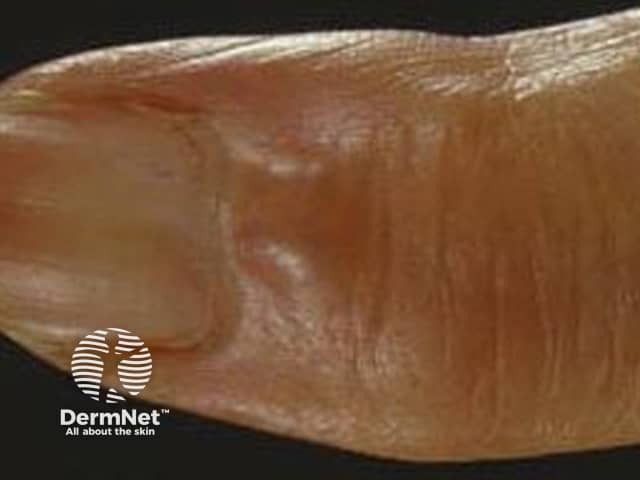
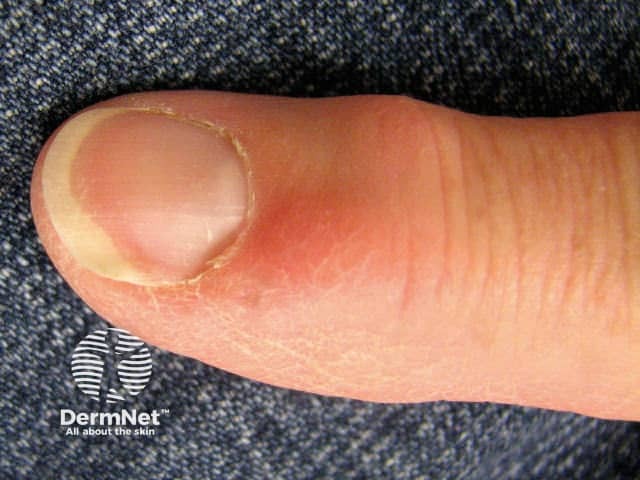
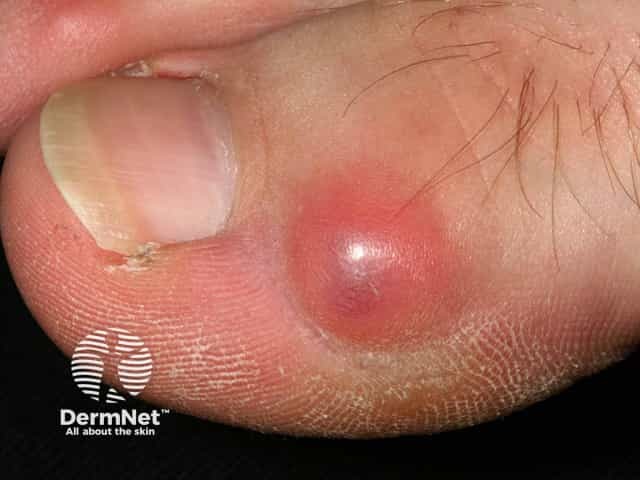


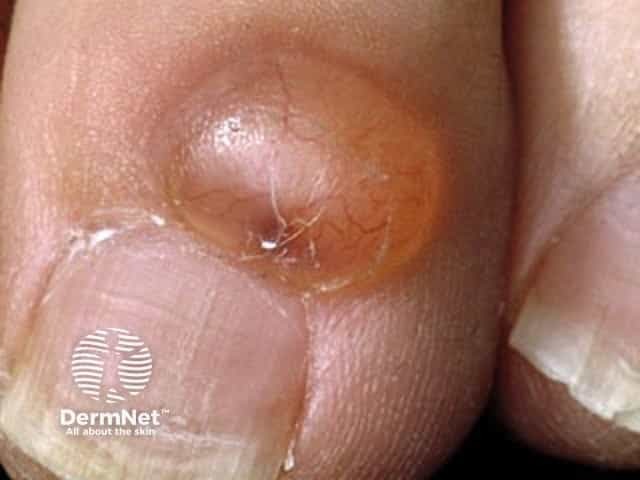
See more images of digital myxoid pseudocysts.
Treatments which may be successful for digital myxoid pseudocyst include:
Unfortunately, digital myxoid pseudocysts often recur, whatever treatment is used.