Mole mapping
What is mole mapping?
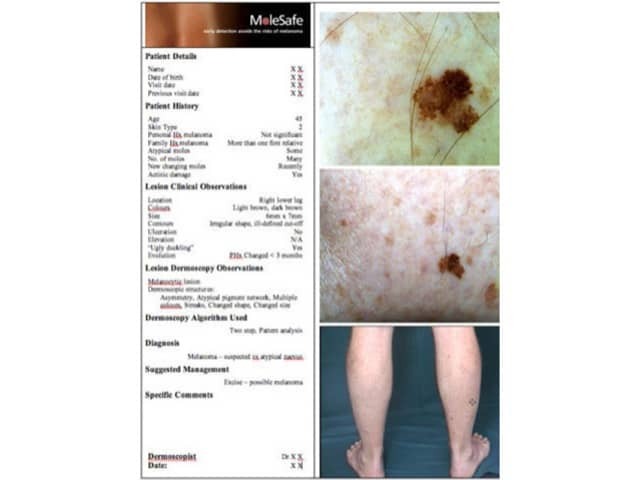
The term ‘mole mapping’ has been used in several different ways. However, it usually refers to a surveillance programme for those at high risk of malignant melanoma. It may include a clinical skin examination and dermoscopy to identify and evaluate lesions of concern.
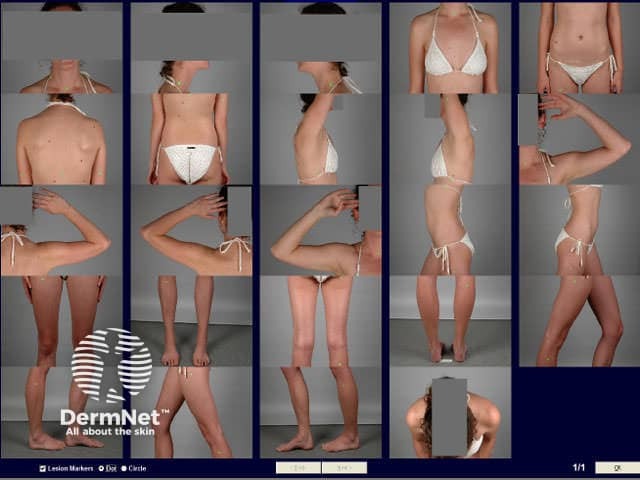
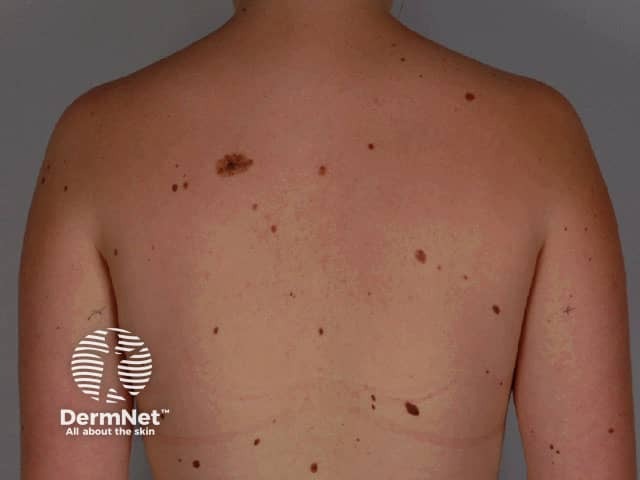
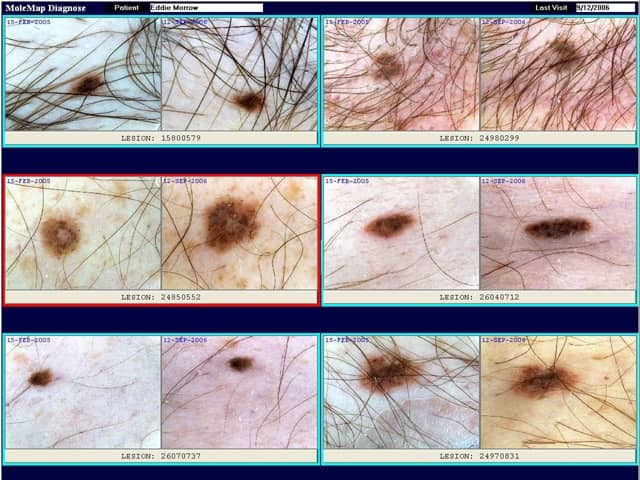
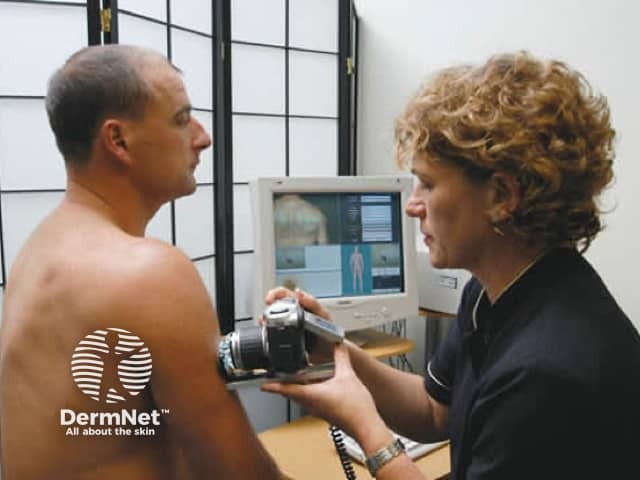
Mole mapping might simply involve marking spots on a cartoon drawing of the body (see self skin examination) to indicate the position of skin lesions of concern, particularly moles and freckles. Mole mapping is more likely to refer to conventional print photographs or digital images of the whole body's skin surface. These can be reviewed at a later date to see if there are any new skin lesions, or whether pre-existing skin lesions have grown or changed colour or shape.
Some systems rely on automated machine detection of new or changed lesions and/or automated diagnosis. These machines are increasingly accurate but should not be used as a substitute for clinical evaluation by a doctor.
Digital mole mapping
Sophisticated digital mole mapping programmes may include the following:
- Risk evaluation i.e. medical and family history, skin typing, sun exposure
- Patient education regarding sun protection, moles and melanoma
- Skin examination by a health professional (usually a doctor or specially trained nurse)
-
High quality digital images (photographs taken with a digital camera)
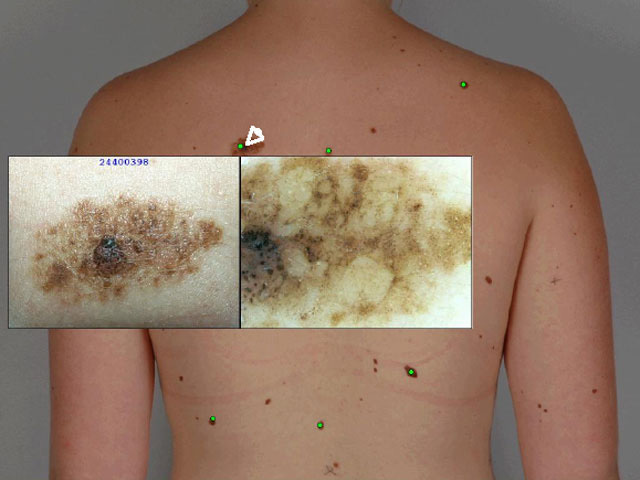
- Standardised poses of the whole body, with lesions of concern carefully localised (this can require very accurate positioning and sophisticated computer programming if there are several similar moles in close proximity)
- Close-up macro images of the lesions of concern
- Dermoscopic images of lesions of concern
- Evaluation of the images by an expert in skin cancer, usually a dermatologist
- A report to the patient and/or referring health practitioner including suspected diagnoses and recommendations for treatment of lesions of concern
- Follow-up mole mapping in 3 to 6 months for lesions of concern that do not reach the threshold for excision
- Follow-up mole mapping of all imaged lesions at intervals of 1 to 2 years or as recommended by your doctor
- A secure database and transfer system to store the images and reports
- Copies of the images for the patient or doctor to aid in self skin examination
The patient will be asked to remove at least outer clothing. Let the staff know if you feel uncomfortable, especially if there are lesions of concern hidden by your underwear. Make-up, nail varnish and jewellery should be completely removed prior to the procedure. Long hair should be tied up.
Which lesions are of concern?
Lesions of concern are those that have features consistent with melanoma or other form of skin cancer (such as basal cell carcinoma or squamous cell carcinoma). Characteristically, skin cancers enlarge or change over periods of weeks to years.
The characteristics of melanoma are defined by the ABCDE rule and the Glasgow 7-point checklist. These are a useful guide, but may not identify early melanomas or atypical forms. Not all skin lesions with these characteristics are melanomas; many turn out to be harmless.
| ABCDE rule | Glasgow 7-point checklist | ||
|---|---|---|---|
|
A
B C D E |
Asymmetry
Border irregularity Colour variation Diameter over 6 mm Evolving (enlarging, changing) |
Major features:
Change in size Irregular shape Irregular colour |
Minor features:
Diameter >7mm Inflammation Oozing Change in sensation |
Nonmelanoma skin cancers are much more common than melanoma. These usually present as growing skin lesions, that may be crusty, ulcerated or bleeding.
If you have any skin lesions that worry you because they are new, enlarging or look distinctive or unusual, ask your doctor's advice.
Who is suitable for mole mapping?
Mole mapping is particularly useful for individuals who have:
- Very many moles (more than 50 to 100)
- Dysplastic or atypical naevi – moles that are large, unusual colour(s) or shapes
- Moles on the back, which may be difficult to keep an eye on
- Previous history of melanoma
- Strong family history of melanoma
- Moles and fair skin that has been severely sunburned
- Concerns about individual moles or freckles, e.g. because of their appearance or recent change
What are the advantages of mole mapping?
Mole mapping is intended to diagnose melanoma at the earliest possible stage, by identifying new melanocytic lesions or change in pre-existing melanocytic lesions. These features may be suspicious of melanoma if the lesion also has a disordered structure clinically or on dermoscopy.
Compared to self skin examination or an examination by a non-specialist doctor, mole mapping as described above has the following advantages:
- The previous record can be used to determine whether a lesion of concern is new or has changed
- If the doctor determines that a lesion has the criteria for removal, this can be done at the earliest possible stage, reducing the risk of melanoma and minimising surgery
- If a lesion is new or has changed, but does not reach the threshold for removal, it can be re-imaged and watched carefully
- Lesions that do have not structural disorder and have not changed are very unlikely to be melanoma so may not need to be removed, reducing the potential cost, risks and complications of surgery
- Digital mole mapping may be undertaken near where you live, reducing the need to visit a dermatologist at a remote centre
- Earlier expert evaluation – in many areas there may be a long delay to get an appointment with a dermatologist
- Reassurance to the patient and their health practitioner(s)
What are the risks of mole mapping?
Mole mapping is a relatively new procedure and is considered experimental by many dermatologists, as it has not yet been proven to save lives. Like all screening systems and other medical procedures, mole mapping is not without risks.
- There may be a melanoma in a hidden site that has not been imaged, such as the scalp or genitals
- Early melanoma may look like a normal mole or other benign skin lesion, and might be missed (false negative)
- A harmless lesion may be misdiagnosed as melanoma, resulting in unnecessary surgery and alarm (false positive)
- Melanoma may grow rapidly, particularly nodular melanoma; it may reach a dangerous size before the next planned visit for mole mapping
- The procedure may be embarrassing
If you are considering undergoing mole mapping, discuss the procedure with your own doctor.
Related information
References:
On DermNet NZ:
Other websites:
- New Zealand Guidelines Group:
- MoleMap New Zealand
- MoleTrac New Zealand
- UK Guidelines for the Management of Cutaneous Melanoma
- Clinical Practice Guidelines for the Management of Cutaneous Melanoma (Australia)
Books about skin diseases:
See the DermNet NZ bookstore