What is radiothermoplasty?
Radiothermoplasty is a form of thermal resurfacing. It is a non-invasive treatment that uses a device to deliver radiofrequency (RF) energy into the deeper layers of skin, which causes a heating action that immediately tightens skin tissue and structures.
One form of radiothermoplasty uses the Thermage® device. It is used to treat facial lines and wrinkles.
The Thermage procedure uses patented radiofrequency technology called ThermaCool™ and ThermaLift™.
How does radiothermoplasty work?
To understand how radiothermoplasty works a basic understanding of skin structure is required. Collagen is a protein molecule that is found in skin, muscle, tendons and bones and provides basic structural support. Through the natural processes of ageing, collagen in the dermis (the mid-layer of skin) is gradually lost and contributes to the formation of facial lines, sagging skin and wrinkles.
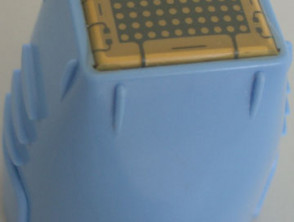
The Thermage procedure uses a special treatment tip (ThermaTip™) to deliver controlled amounts of RF energy into the collagen layers of the skin. This form of energy produces a heating action that penetrates the collagen and causes it to contract and tighten. Also, collagen production is triggered, and over about six months, new collagen grows to tighten the skin further.
What does radiothermoplasty involve?
The following is an outline of the Thermage procedure. Other radiothermoplasty procedures may be similar.
Pre-treatment assessment/preparation
- Define problem areas and tailor a treatment pattern to target the areas for correction.
- Take pre-treatment photographs.
- The patient needs to remove all jewellery and makeup. Wash face with soap and water before treatment.
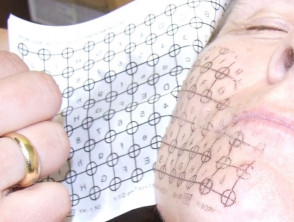
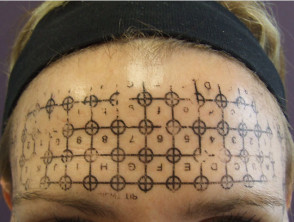
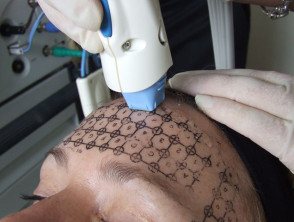
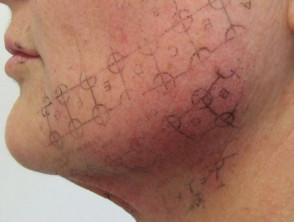
- A treatment grid is applied to the face to guide and direct treatment, so all necessary areas are treated without inadvertent overlapping of RF delivery.
Thermage treatment grid
Application of RF energy
- No topical or injected local anaesthetic, sedative or painkillers are necessary in most cases.
- A fluid called coupling fluid is applied to the treatment areas, which provides a conductive medium to ensure good electrical and thermal contact with the skin and the treatment tip.
- Via the treatment tip, a combination of cooling spray and RF energy is delivered. The cooling spray continuously cools the outer layers of the skin to prevent any burning.
- Depending on your pain threshold, you may feel nothing, mild warmth, intense warmth (heat), or possibly pain with each application of energy.
- Throughout the procedure, your doctor/nurse will need feedback from you about your perception of heat and the level of pain or discomfort you are experiencing. RF levels will be adjusted up or down accordingly so that therapeutic levels of heat are achieved without excessive discomfort.
- Treatment time varies according to the area(s) treated and the number of times the tip is passed over the skin. A Thermage procedure can take anything between 1 to 2 hours from start to end.
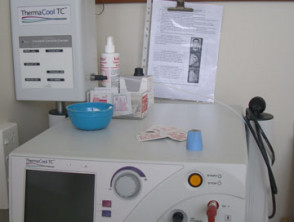
Thermage procedure
Thermage recovery
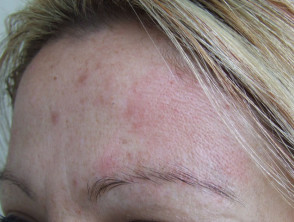
- Some redness and swelling may be experienced after the procedure, which may last for 1-2 hours, or at most, for a few days. The redness may be covered with makeup.
- Results are difficult to predict. It appears to be ineffective for some people. Some see an improvement immediately or within a few weeks, while others only see improvement after 2-3 months. New collagen is growing for up to 6 months after treatment so improvements should be visible right up till this time.
- Take post-treatment photographs at 1-2 month intervals following treatment
Thermage is a relatively new cosmetic procedure. People treated in the early years still appear to be showing benefits from the treatment. It is thought that benefits from Thermage may last as long as 5-10 years but only time will tell.
Mild redness immediately after treatment
Who is suitable for radiothermoplasty?
Although radiothermoplasty has been touted as a “non-surgical facelift”, it is not a substitute for a facelift. Radiothermoplasty can provide some of the improvements that cosmetic facial surgery gives to people, but in a portion of people, no improvements will be seen after radiothermoplasty. Radiothermoplasty is best performed during the early signs of ageing such as:
- early jowling
- loosening skin
- creasing around the nose and mouth
- wrinkling around the nose and mouth
The Thermage procedure appears to work best in people with thin faces who are just on the verge of considering cosmetic facial surgery. People with very loose skin, sagging jowls and a turkey gobbler may see little improvement after Thermage and are better suited for cosmetic surgery. If surgery is not an option, then Thermage may provide some improvements, but expectations need to be managed.
Thermage works well on people with all skin types, unlike laser treatments that can cause permanent loss or variable pigmentation in darker skinned individuals.
What are the side effects and complications of radiothermoplasty?
To date, the reported incidence of side effects from Thermage radiothermoplasty is less than 1%. Some of the more common side effects and complications include:
- swelling and redness
- risk of burn, blistering and scarring
- tingling and burning sensation for a few days after treatment
- soreness, particularly around the jawline
A more serious complication is the formation of dents in the skin (rare). This is attributed to overheating of tissue causing fat atrophy or excessive tightening. Adhering to treatment guidelines and responding to patient feedback throughout the procedure may prevent this.