logo

DermNet NZ

Ad

Facts about skin from the New Zealand Dermatological Society Incorporated. Topic index: A B C D E F G H I J K L M N O P Q R S T U V W X Y Z

Hereditary focal palmoplantar keratoderma

What are focal keratodermas?

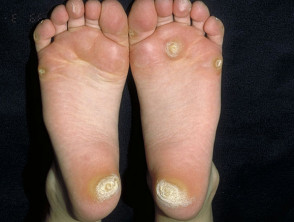
Focal keratodermas are palmoplantar keratodermas that involve only some areas of the palms or soles, usually over pressure points. Some types are associated with abnormalities in organs other than the skin.

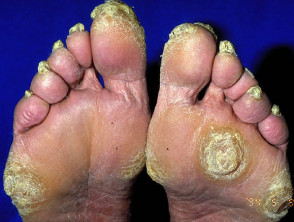
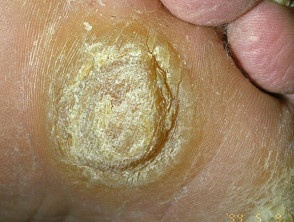
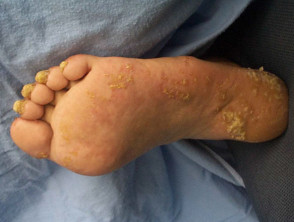
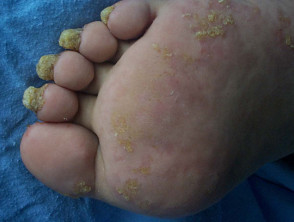
Focal palmoplantar keratoderma Focal palmoplantar keratoderma Focal palmoplantar keratoderma
Focal palmoplantar keratoderma (areata type)
What causes focal keratodermas?

Hereditary focal palmoplantar keratodermas are caused by a genetic abnormality. They may be inherited from one affected parent (autosomal dominant inheritance) or from both parents, who are generally unaffected (autosomal recessive inheritance). Several family members may be affected. Some types of keratoderma are associated with abnormalities of internal organs.

What are the different types?

The many different types of focal hereditary palmoplantar keratoderma (PPK) look very similar. Some types are associated with abnormalities of organs other than the skin.

PPK striata/areata type
Hereditary painful callosities
  • Autosomal dominant inheritance
  • DO NOT affect organs other than the skin
  • Small areas of skin thickening on palms and soles in childhood
  • ‘Striate’ type: thick lines (particularly on palms or fingers)
  • ‘Areata’ type: circles (particularly on soles of the feet)
  • In most cases, mixed striate and areata thickenings
  • May resemble corns on the soles of the feet
  • Hereditary painful callosities affect only the feet
Howell-Evans syndrome
  • Autosomal dominant inheritance
  • Childhood onset of focal keratoderma
  • Oesophageal cancer in middle age
  • White areas may be seen inside the mouth (leukokeratosis)
Richner-Hanhart syndrome
  • Autosomal recessive inheritance
  • Due to an enzyme deficiency
  • Characterised by ulcers on the eye and dislike of bright light in the first year of life
  • Focal keratoderma in late childhood or adolescence
  • Most children develop mental retardation
  • Restriction of phenylalanine and tyrosine in the diet is required to improve symptoms and may prevent progression of mental retardation
Pachyonychia congenita
  • Autosomal dominant inheritance
  • Thickened wedge-shaped nails
  • White areas may develop along the tongue and inside of the mouth (leukokeratosis)
  • Type 1 (Jadassohn-Lewandowsky type) results in more severe focal keratoderma
  • Type 2 (Jackson-Lawler type) results in milder focal keratoderma but may have formed teeth at birth, hair abnormalities (pili torti), and develop multiple pilosebaceous cysts after puberty (steatocystoma multiplex)
Striate PPK with woolly hair and dilated cardiomyopathy
  • Autosomal recessive inheritance
  • Coarse ‘woolly’ hair from birth
  • Focal keratoderma develops in infancy
  • Heart disease develops in adolescence
  • May result in clubbing of the nails
  • Blistering of the skin may occur
Pachyonychia congenita Pachyonychia congenita
Pachyonychia congenita

Treatment of focal keratoderma

The following treatments soften the thickened skin and make them less noticeable.

What is the prognosis?

These conditions persist for life and may be passed on to the next generation.

Related information

References:

On DermNet NZ:

Other websites:

Books about skin diseases:

See the DermNet NZ bookstore

Author: Dr Amy Stanway, dermatology registrar, Nottingham

DermNet does not provide an on-line consultation service.
If you have any concerns with your skin or its treatment, see a dermatologist for advice.