Introduction
Demographics
Causes
Clinical features
Diagnosis
Treatment
Outcome
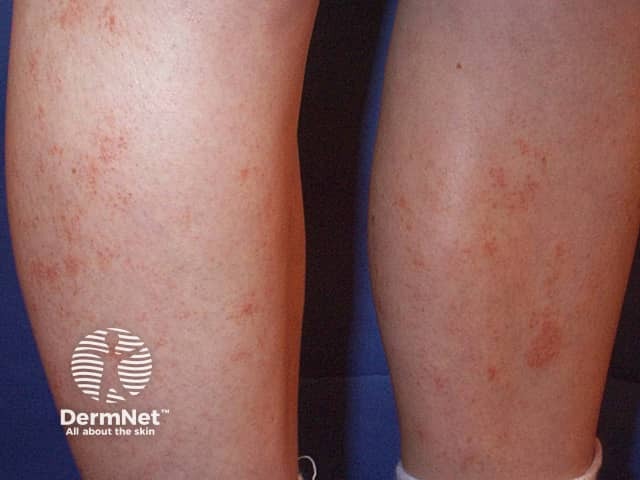
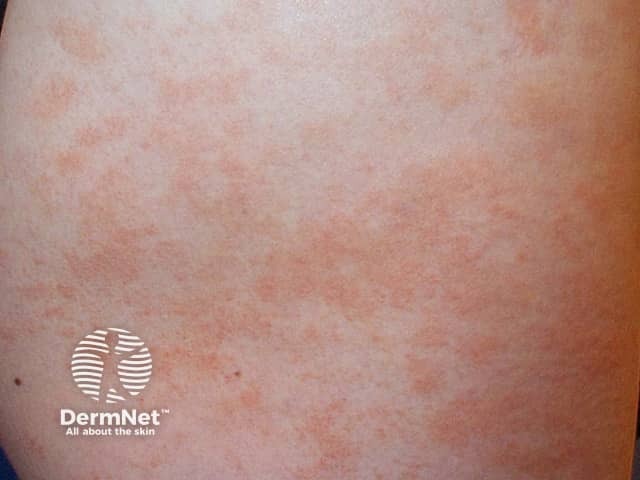
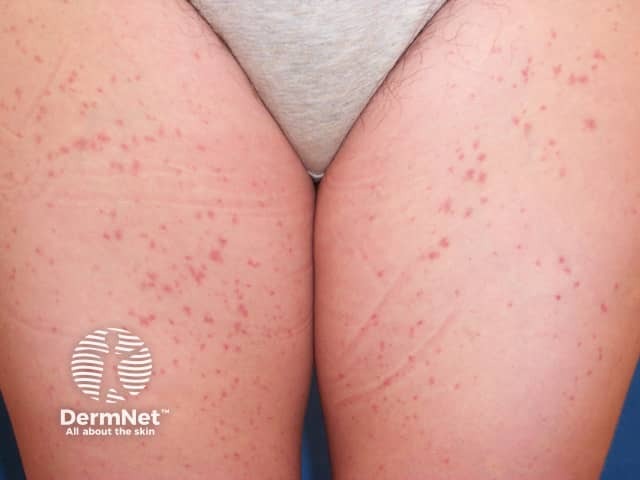
Capillaritis is a harmless skin condition in which there are reddish-brown patches caused by leaky capillaries. It is also known as pigmented purpura.
See more images of capillaritis
Capillaritis can affect anyone, but is uncommon in children.
The capillaries are small blood vessels near the skin surface. For unknown reasons they sometimes become inflamed, although a true vasculitis is not seen on skin biopsy. Blood cells may pass through small gaps that arise between the cells, which make up the capillary walls. The result is petechial haemorrhages. These fade away depositing haemosiderin in the upper parts of the dermis.
Capillaritis is classified according to its appearance. It is characterised by tiny red and brown dots, described as cayenne pepper spots. These may be scattered over a body region or group together to form a flat red patch, which becomes brown and then slowly fades away over weeks to months. The clinical descriptions are named after the dermatologist who first described them
Schamberg disease is the most common type of capillaritis. Regular or irregular crops of red-brown flat patches with cayenne pepper spots on their borders appear for no apparent reason. Although most common on the lower legs, the Schamberg form of capillaritis can arise on any part of the body. It is usually irregularly distributed on both sides with few or many patches. There are no symptoms.
Doucas-Kapetanakis eczematid-like purpura appears similar to Schamberg disease, but itches. Reddish-purple macules appear around the ankles and may spread up the legs. Itching purpura can also affect trunk and upper limbs. Itching leads to scratching and lichenification.
Gougerot-Blum capillaritis is less common. The patches are thickened and itchy, rather like eczema, but pathology is of a lichenoid reaction.
In this condition there are dilated capillaries as well as brown patches and cayenne spots. Annular patches gradually spread outwards and form concentric rings.

Capillaritis has been reported to be due to khaki clothing dye and to rubber. It only affects skin in contact with the responsible material.
Lichen aureus is a solitary brown-yellow patch that is very persistent. It often overlies a varicose vein.
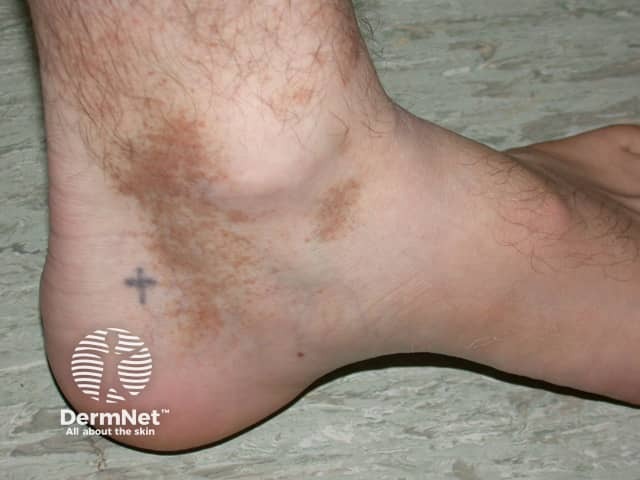
Capillaritis may develop on the ankles following prolonged or vigorous exercise (eg, after 18 holes of golf, tramping, or dancing), especially during warm weather. The spots fade to brown within a few days and eventually disappear. A burning sensation may occur as the new lesions appear. Exercise-induced capillaritis can occur on a single occasion or recur regularly after exercise.

Capillaritis is usually a clinical diagnosis. The diagnosis may be supported by dermatoscopy (the petechiae are seen more clearly) and skin biopsy. No other investigations are necessary in most cases. See also lichen aureus pathology.
As capillaritis is a mild condition, most patients do not require treatment. There is no known cure.
Capillaritis can disappear within a few weeks, recur from time to time, or persist for years.