Introduction
Demographics
Causes
Clinical features
Complications
Diagnosis
Differential diagnosis
Treatment
Prevention
Outcome
Midfacial toddler excoriation syndrome (MiTES) is a rare, autosomal recessive, dysaesthetic disorder starting in infancy that is characterised by severe, self-inflicted facial excoriation with subsequent scarring and dyspigmentation.
Midfacial toddler excoriation syndrome is extremely rare, with the first case being identified in 2017. Onset is typically between 6–12 months of age, and the sex distribution has been reported as roughly equal, though one review noted a male predominance. Parental consanguinity is associated with MiTES.
Midfacial toddler excoriation syndrome is a protein-aggregation disorder caused by biallelic mutations in the PR domain-containing protein 12 (PRDM12) gene, specifically an expansion of the polyalanine tract. This tract normally consists of 7 to 15 alanine residues, whereas the presence of 16 to 18 alanines has been linked to MiTES and causes intracellular PRDM12 protein clumping in vitro.
The PRDM12 protein is a transcriptional regulator integral to the development of nociceptive (pain-sensing) neurons.
Cutaneous features:
Non-cutaneous features:
Pain sensation is typically preserved in patients with MiTES, but mild pain insensitivity in the face and extremities has been reported in the literature.
Darker skin types are more prone to post-inflammatory pigmentary changes; secondary erythema is more easily appreciable on lighter skin types.
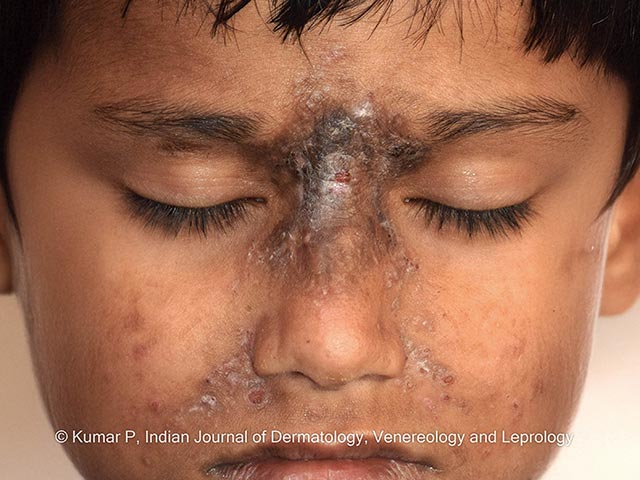
Midfacial toddler excoriation syndrome is typically diagnosed through a combination of clinical evaluation, exclusion of other conditions, and genetic testing where available.
Suggestive history and exam findings:
MiTES can be definitively diagnosed by identifying biallelic PRDM12 mutations on genetic testing.
There is no cure for midfacial toddler excoriation syndrome. Treatment primarily focuses on managing the scratching behaviour, promoting skin healing, and addressing any underlying emotional or behavioural factors. These include:
There is no known way to prevent midfacial toddler excoriation syndrome. Reproductive genetic counselling and pre-implantation genetic testing can be offered to known carriers of a pathogenic variant or affected individuals.
Midfacial toddler excoriation syndrome is self-limited in most cases, with the itching and excoriation behaviours subsiding during the first decade of life. While excoriated skin typically heals with skin care, scarring and pigmentary changes can persist.