Introduction
Indications and contraindications
Closure technique
Benefits
Disadvantages and side effects
Surgical wound closure refers to a spectrum of techniques used to close wounds — whether inflicted by trauma or surgery — and minimise complications such as dehiscence, infection, and poor cosmesis.
The most common approach is primary closure (or healing by primary intention), which directly approximates wound edges using sutures, surgical staples, or adhesives.
Reconstructive surgeons often consider the ‘reconstruction elevator’ (previously the ‘reconstructive ladder’), which outlines wound closure options from simple to complex, moving up the hierarchy only as necessary:
Closure option |
Description |
Indication |
|||||
|---|---|---|---|---|---|---|---|
Donor tissue from a distant site is transferred with its blood supply reattached at the recipient site |
Large defects with significant tissue loss and no regional options |
||||||
Tissue is transferred from a nearby site while maintaining its intrinsic blood supply |
Large defects with significant tissue loss |
||||||
Adjacent tissue is manipulated to cover the defect |
Defects in non-graftable areas with significant laxity |
||||||
Skin lacking an intrinsic blood supply is transferred from one site to another |
Wounds with tissue loss; post-surgical excision sites |
||||||
Delayed primary closure (aka tertiary closure) |
Closure of the cleaned wound occurs after a 3-5 day observation period |
Contaminated wounds |
|||||
Primary closure |
Wound is closed with an adjunct such as sutures, surgical staples, or glue |
Clean wounds with minimal tissue loss and easily approximated wounds; cosmetically sensitive areas |
|||||
Secondary intention healing |
Wound is intentionally left open to heal from the bottom up through granulation, contraction, and epithelialisation |
Small superficial abrasions and lacerations; certain concave facial structures |
|||||
For information on skin flaps and skin grafting, see their respective pages.
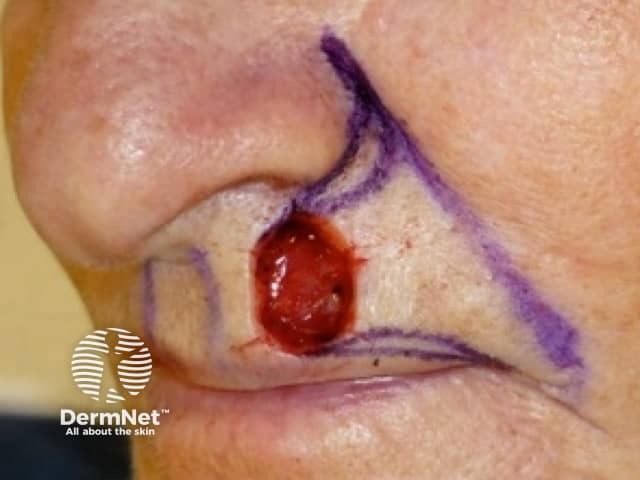
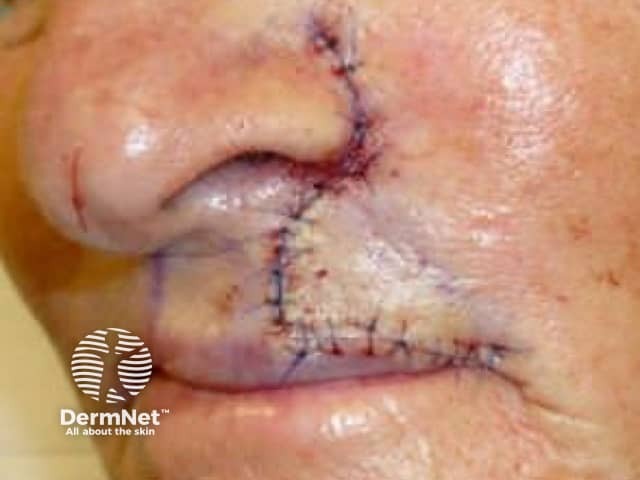
Clinicians should consider wound depth and the potential for damage to underlying structures (eg, nerves, joints, tendons, fascia, major vessels) before proceeding with closure. Concerns regarding function, sensation, or local blood supply should prompt referral to the appropriate speciality.
Wound closure concerns in the community setting may require referral to tertiary care eg, emergency medicine or plastic surgery.
Most simple clean wounds can be approached with primary closure or healing by secondary intention.
Primary closure
Secondary intention healing
Traumatic wounds are often contaminated as a result of the injury. This can be due to direct trauma from foreign objects, environmental debris, or pathogen-contaminated implements, such as teeth and animal claws.
Preparatory steps
Delayed primary closure
Following decontamination, the wound can undergo delayed primary closure. This involves leaving the wound open for a brief waiting period (often 3–5 days) before the wound edges are surgically approximated. The delay allows for natural host defences to reduce bacterial load and for non-viable tissue to declare itself for debridement.
Secondary intention healing
Abscess cavities or other purulent wounds are purposely left open to heal by secondary intention to facilitate ongoing drainage.
Important principles should be adhered to during wound closure for optimal outcomes:
For more information, see: suturing techniques.
Selecting the suboptimal closure technique can lead to complications with the wound itself:
Secondary intention healing has its own disadvantages:
Risk factors for wound infection and dehiscence: