Introduction
Demographics
Causes
Clinical features
Variation in skin types
Complications
Diagnosis
Differential diagnosis
Treatment
Prevention
Outcome
Cutaneous collagenous vasculopathy (CCV) is a rare, acquired, idiopathic microangiopathy affecting the dermal blood vessels. It presents with multiple telangiectases without systemic involvement.
Although asymptomatic and benign, this condition is incurable and often progressive.
Due to its clinical resemblance to generalised essential telangiectasia, CCV is frequently misdiagnosed.
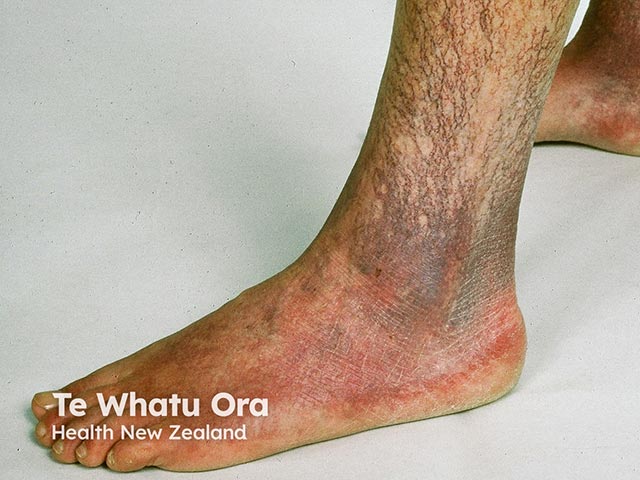
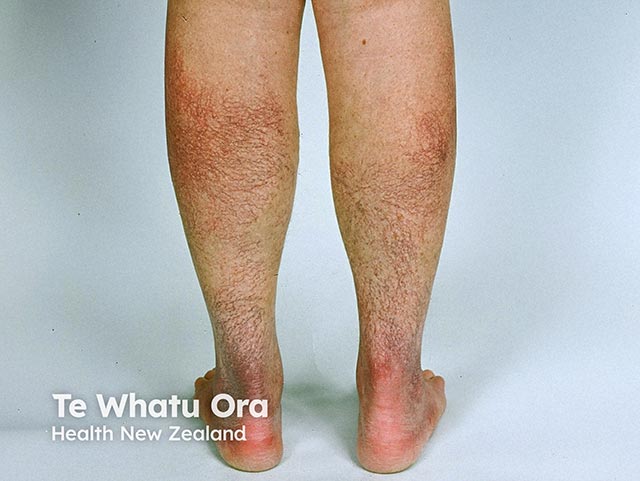
Cutaneous collagenous vasculopathy predominantly affects middle-aged to older individuals of Caucasian descent, with an equal distribution between genders.
It is a rare disease, though believed to be underdiagnosed or commonly misdiagnosed as generalised essential telangiectasia.
Most reported cases have been identified in individuals with underlying systemic conditions (eg, diabetes mellitus, autoimmune disorders, or cardiovascular disease) and taking at least one medication. However, no definitive association with a specific condition or medication has been established to date.
The aetiopathogenesis of cutaneous collagenous vasculopathy remains poorly understood. One proposed mechanism suggests that repeated endothelial injury triggers the activation of veil cells (immature dendritic cells), which in turn promote the deposition of abnormal collagen within the basement membrane of superficial dermal vessels. This process ultimately leads to fibrosis of the vessel walls.
Cutaneous collagenous vasculopathy typically:
Over time, additional features such as ecchymoses and petechiae may develop.
Cutaneous collagenous vasculopathy predominantly occurs in individuals with fair skin, most commonly those of Caucasian descent.
Cutaneous collagenous vasculopathy is not known to cause any medical complications. However, patients may experience psychological distress due to cosmetic concerns or uncertainty regarding their condition.
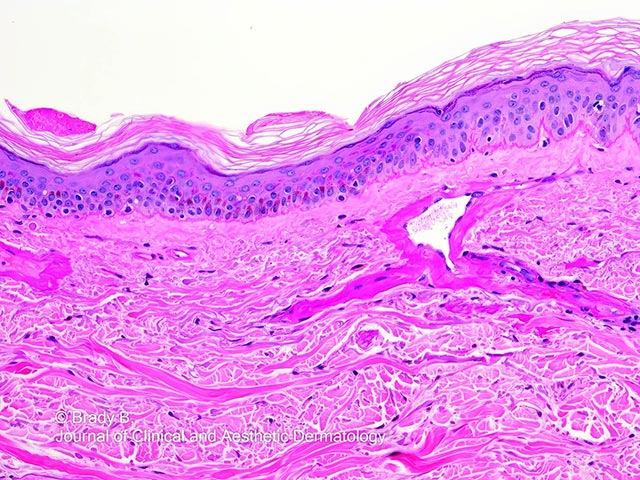
The diagnosis of cutaneous collagenous vasculopathy is established by correlating clinical features with characteristic histopathological findings.
Histopathological findings:
Electron microscopy further confirms the diagnosis by identifying hallmark features such as veil cells and Luse bodies, which represent abnormal collagen deposits.
Other investigations:
The primary differential diagnosis for cutaneous collagenous vasculopathy is generalised essential telangiectasia (GET)
Other conditions that may present with widespread telangiectasia and should be considered in the differential diagnosis include:
No specific treatment is needed, as cutaneous collagenous vasculopathy is benign, asymptomatic, and does not lead to systemic complications. Specific treatments are available to improve aesthetic outcomes, though none are curative.
There is no known way to prevent cutaneous collagenous vasculopathy as the underlying aetiology remains to be identified.
Cutaneous collagenous vasculopathy is a chronic, benign condition that remains asymptomatic and without systemic involvement.
CCV can progress over time, leading to the formation of microvarices, darkening of telangiectasias, and hyperkeratosis. Treatment is not necessary, but options are available to improve the cosmetic appearance.