Author: Madeleine Tropman, Junior Medical Officer; Dr Timothy Gilbey, Consultant Physician, Wagga Wagga Base Hospital, Australia (2026)
Reviewing dermatologist: Dr Ian Coulson
Edited by the DermNet content department
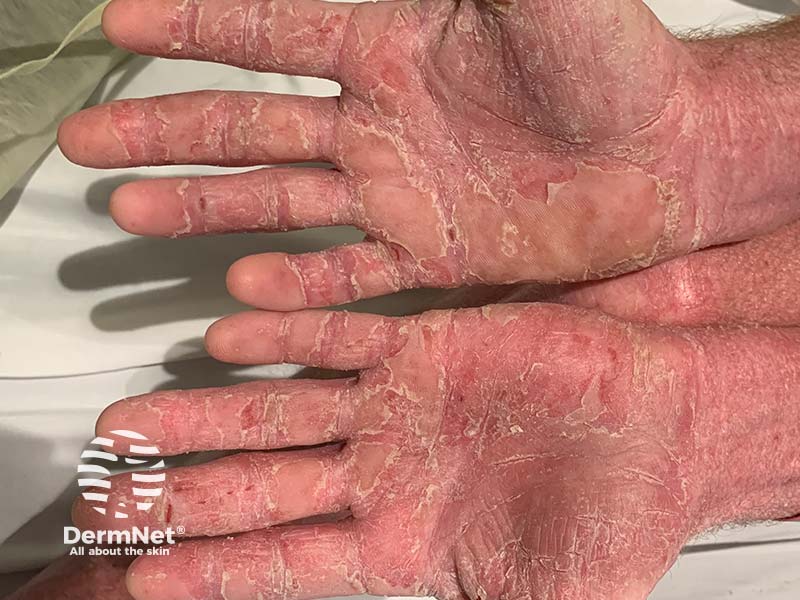
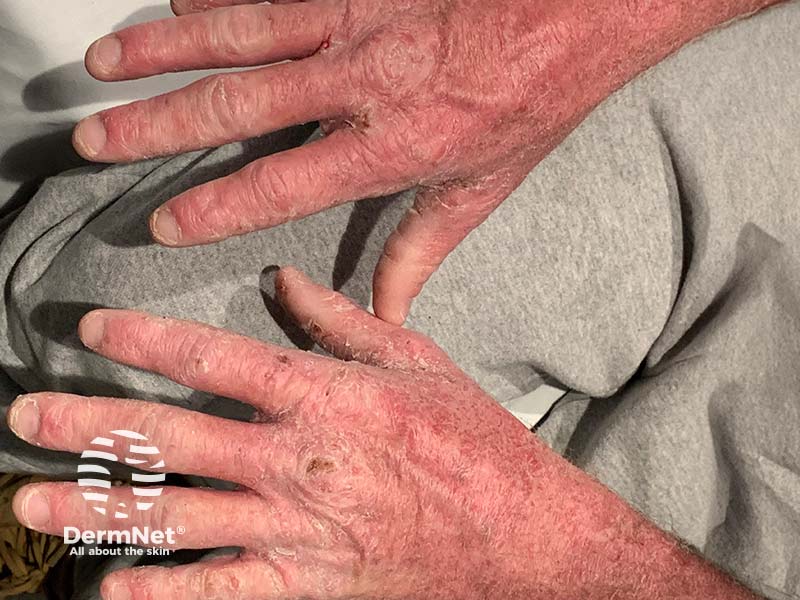
A 40-year-old male presents with a 2-month history of a spreading eruption that started around his groin and has extended to involve his whole body. The rash is dry and desquamating, with thickened fissured skin affecting his palms and soles. He has associated fatigue, fevers, and rigors.
This patient had no prior medical history and no episodes of rash prior to the onset of this condition. He had taken a course of cefalexin and steroids over the past few weeks, with no noticeable change to the rash.
Differentials are wide, and include:
Is there a family or past history of skin problems?
Has there been scalp problems in the past?
Has there been red patches on the elbows or knees?
Is there a history of atopy?
Biopsy can be helpful in distinguishing the underlying cause.
Pustules could indicate either infection or the presence of generalised pustular psoriasis.
He has diffuse erythroderma and palmoplantar keratoderma with fissuring of the palms and fingers.
Erythrodermic psoriasis: a severe form of psoriasis that accounts for one third of erythroderma presentations. It can be precipitated by a wide range of triggers including steroid withdrawal, infection, hypocalcaemia, medications and excessive alcohol. It has a high risk of complications including secondary infection, dehydration, hypothermia, protein loss, heart failure, and death.
He is suffering from acute skin failure.
This can result in:
Treatment requires hospital admission for supportive care including fluid resuscitation and temperature regulation. Any likely secondary infection should be treated with empiric antibiotics, as in this case. Emollients are applied liberally, with commencement of systemic immunomodulatory drugs such as low-dose methotrexate, ciclosporin, or acitretin.