What is melanoma?
Role of genes in melanoma
Inherited gene mutations with melanoma risk
Non-inherited gene mutations with melanoma risk
Genetic testing
Melanoma is a life-threatening skin cancer that originates from melanocytes, the pigment-producing cells responsible for skin colouration. Melanoma is predominantly observed in individuals with fair skin, especially those with red or fair hair and a tendency to freckle.
Several genes are implicated in the development of melanoma. This includes both acquired (somatic) mutations driven by environmental factors — such as excessive ultraviolet radiation from sun exposure — and inherited (germline) mutations which predispose an individual to melanoma. Knowledge of these mutations can provide insight into drug therapy, prognosis, and related malignancies.
The majority of melanoma cases are sporadic; only 10% of melanoma cases report a family history. Furthermore, family history does not necessarily indicate transmission of a pathogenic gene variant within those families. Most familial melanoma cases reflect shared sun exposure among members with fair skin types, who are more susceptible to DNA damage. Different genetic mutations have varying penetrance, and not all people with the same mutation will develop melanoma.
The risk of melanoma is elevated within families if:
The cyclin-dependent kinase inhibitor 2A (CDKN2A) gene is a tumour suppressor gene located on chromosome 9. Germline mutations of CDKN2A are the most frequently identified cause of familial melanoma, accounting for an estimated 20–45% of cases in families with three or more melanoma cases, and elevate the risk of melanoma by up to 65-fold.
Individuals with CDKN2A mutations typically develop melanoma approximately 15 years earlier than the general population. The median age at diagnosis of melanoma among these mutation carriers is 33–45 years, whereas in the wider population it is 53–61 years.
CDKN2A is considered a high-penetrance gene for hereditary melanoma, but not all individuals with pathogenic CDKN2A variants will develop the disease. This suggests that melanoma development is additionally influenced by other factors eg, age, environmental exposures (including UVR), other medical conditions, and other genetic variants.
Mutations in the CDKN2A gene disrupt the function of two proteins it encodes: p16INK4a (p16) and p14ARF (p14).
CDKN2A is associated with familial atypical multiple mole melanoma (FAMMM) syndrome, which is inherited in an autosomal dominant pattern.
FAMMM syndrome features:
A specific subtype of FAMMM called melanoma-astrocytoma syndrome (MAS) is also linked to CDKN2A. The mutations in MAS are more strongly associated with defective p14.
Like FAMMM, people with MAS develop dysplastic naevi and early melanoma, but they are also at increased risk of tumours of the nervous system eg, astrocytomas, neurofibromas, schwannomas.
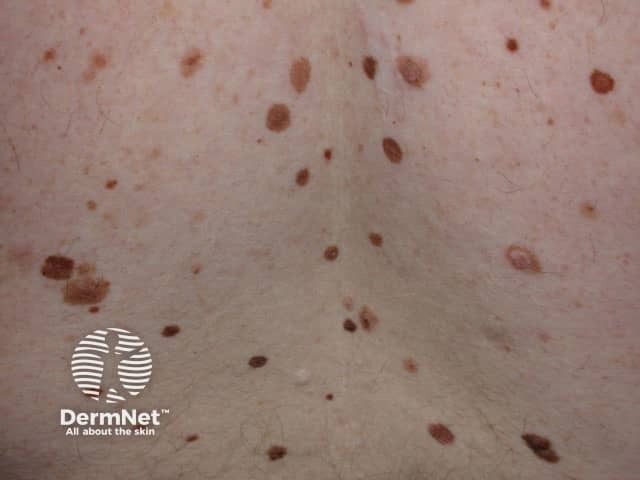
Familial atypical naevi — note the irregularity and ‘fried egg’ appearance of some naevi.
Other genes associated with hereditary melanoma risk are listed below in alphabetical order.
The agouti signalling protein (ASIP) gene plays a major role in pigmentary regulation. The agouti signalling protein inhibits the melanocortin 1 receptor (MC1R) on melanocytes, shifting melanogenesis away from eumelanin towards pheomelanin.
Because pheomelanin provides substantially less photoprotection than eumelanin, activating mutations of ASIP increase susceptibility to UV-induced DNA damage, thereby elevating the risk of melanoma.
The BRCA1-associated protein 1 (BAP1) gene, located on chromosome 3, is a tumour suppressor gene. Germline BAP1 mutations are inherited in an autosomal dominant fashion and are associated not only with an elevated risk of cutaneous melanoma but also various cancers, including mesothelioma, renal cell carcinoma, uveal melanoma, basal cell carcinoma (BCC), and possibly other cancers as well.
Germline mutations in BAP1 are generally associated with earlier onset and poorer prognosis. The median age of onset for cutaneous melanoma in these individuals is 45 years compared to 58 years in the general population.
Approximately 13% of carriers of a germline BAP1 mutation will develop a cutaneous melanoma. For more information, see: Germline BAP1 mutation and BAP1 inactivated melanocytic tumours
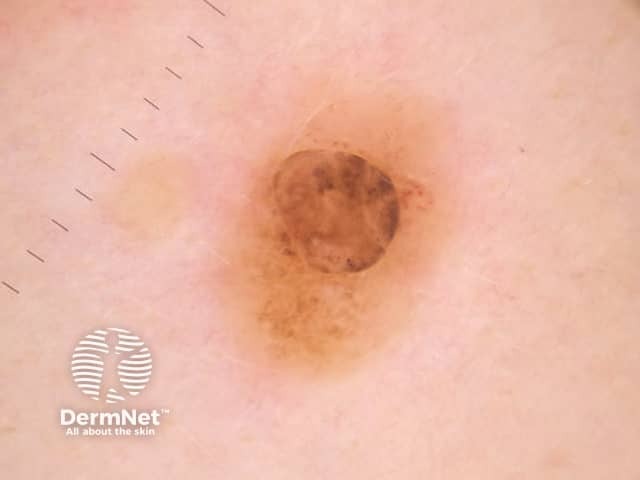
The cyclin-dependent kinase 4 (CDK4) gene plays an essential role in regulating the transition from the G1 phase to the S phase of the cell cycle. CDK4 mutations render the CDK4 protein resistant to inhibition by p16 (encoded by CDKN2A — see above), leading to cell proliferation.
Germline CDK4 mutations are inherited in an autosomal dominant pattern and are rarer than CDKN2A mutations, but confer a similar penetrance for melanoma. The median age of melanoma diagnosis is 39 years.
Germline CDK4 mutations have also been rarely reported in cases with FAMMM syndrome and pancreatic cancer.
The melanocortin 1 receptor (MC1R) gene encodes a protein involved in the regulation of hair and skin colour. MC1R mutations that decrease the production of eumelanin (a brown-black photoprotective pigment) are associated with a higher risk of sunburn and sporadic melanoma.
Melanomas linked to germline MC1R mutations exhibit a significantly higher burden of somatic mutations, indicating an increased susceptibility to tumour development in these individuals. Notably, MC1R variants have been shown to enhance the penetrance of co-existing CDKN2A mutations, doubling the risk of developing melanoma.
The MDM2 gene on chromosome 12 encodes the MDM2 protein, which facilitates the breakdown of the p53 tumour suppressor protein. Therefore, the overexpression of MDM2 with mutations is linked to more rapid cancer progression and a diminished response to therapeutic interventions.
Research has linked mutations in MDM2 to an increased risk of developing melanoma at a younger age (under 50 years) in women.
The microphthalmia-associated transcription factor (MITF) gene is a melanocyte-specific transcription factor that plays a critical role in melanocyte pigmentation, differentiation, proliferation, and survival.
Germline MITF E318K mutations that disrupt a conserved SUMOylation site (critical to post-translational regulation) are associated with a 2.2 to 5 times higher risk of developing melanoma compared to the general population.
The RB1 gene on chromosome 13 encodes the retinoblastoma protein (pRB), a crucial tumour suppressor that prevents inappropriate cell cycle progression at the G1/S checkpoint. RB1 mutations are responsible for most cases of retinoblastoma.
Germline mutations in the RB1 gene also elevate the risk of developing melanoma and other cancers, such as osteosarcoma, rhabdomyosarcoma, and pinealoma.
The adenocortical dysplasia (ACD), telomeric repeat binding factor 2 interacting protein (TERF2IP), and protection of telomere 1 (POT1) genes encode proteins that are components of the shelterin protein complex. Shelterin is important for protecting telomeres against degradation during cellular division and regulating telomerase activity.
ACD and TERF2IP are located on chromosome 16; POT1 is located on chromosome 7.
ACD and TERF2IP mutations:
POT1 mutations:
The telomerase reverse transcriptase (TERT) gene on chromosome 5 encodes the catalytic subunit of the enzyme telomerase. Telomerase activity is observed in the majority of cancers, where it maintains telomere length during DNA replication, thereby preventing senescence and sustaining cell proliferation.
TERT promoter mutations drive reactivation of TERT expression, thereby increasing telomerase activity and contributing to cancer development.
A TERT promoter mutation has been identified in two unrelated families with multiple cases of melanoma. Additionally, TERT promoter mutations seem to significantly increase the risk of lymph node metastasis or mortality in cases of Spitzoid melanoma.
These mutations have been linked to a poor prognosis, especially when accompanied by BRAF or NRAS mutations.
The tyrosinase (TYR) gene encodes tyrosinase, a key enzyme in melanin synthesis. The tyrosinase-related protein 1 (TYRP1) gene encodes a protein that stabilises tyrosinase, promoting its role in eumelanin synthesis.
TYR and TYRP1 variants that reduce tyrosinase activity and, therefore, eumelanin levels can increase susceptibility to UV-induced DNA damage and subsequent melanoma.
Exposure to environmental factors, particularly UV radiation, can lead to mutations in certain genes that are not inherited but rather acquired throughout life. These acquired mutations significantly contribute to the risk of melanoma.
The BRAF gene encodes a protein called B-Raf, which is part of the RAS/RAF/MEK/ERK signalling pathway. This pathway plays a pivotal role in regulating cell division, differentiation, and survival.
BRAF mutations are the most prevalent somatic mutation associated with the development of melanoma. Approximately 40–60% of UV-related melanoma cases harbour BRAF mutations, most of which are the BRAF V600E variant.
The epidermal growth factor (EGF) gene encodes a protein that binds to the epidermal growth factor receptor (EGFR) on cell surfaces, initiating pathways involved in cell proliferation and tissue repair. However, EGF mutations can lead to overactive signalling, promoting abnormal cell growth and increasing the likelihood of melanoma development. EGF mutations confer a poorer survival prognosis and increased risk of metastasis.
The FAS gene encodes the Fas receptor protein, which is also known as TNFRSF6, APO-1, and CD95. This is a key cell-surface molecule that enables surveillance of UV-damaged skin cells and prevents cell transformation by initiating apoptosis.
Research has linked somatic mutations in FAS to melanoma development, likely due to loss of apoptotic function.
Mutations in this gene have also been linked to autoimmune lymphoproliferative syndrome (ALPS). ALPS is characterised by abnormal lymphocytes, lymphadenopathy, hepatosplenomegaly, autoimmune diseases, and an elevated risk of lymphoma.
The phosphatase and tensin homolog (PTEN) gene is a tumour suppressor gene on chromosome 10 that regulates cell growth, proliferation, and survival through the PI3K pathway. Somatic PTEN mutations occur in 30–50% of melanomas and are associated with poorer responses to immune blockade therapies and worse overall survival.
In addition to somatic mutations, a pathogenic germline variant of PTEN is associated with Cowden syndrome, an autosomal dominant disease associated with a significant risk for multiple cancers. Melanoma has been observed in 5% of cases with Cowden syndrome.
The following four clinical scenarios may indicate the need for genetic counselling and testing for hereditary melanoma.
Diagnoses at younger ages than typical may suggest a hereditary syndrome. Globally, the average age of melanoma diagnosis is between 50 and 60 years, whereas in families with CDKN2A mutations, it averages around 35 years. However, early onset alone is not a definitive indicator of germline pathogenic variants.
Multiple melanoma cases within a family may suggest a genetic predisposition. Research has shown that the likelihood of identifying a pathogenic variant in CDKN2A increases with the number of affected family members, reaching approximately 70% when six or more relatives are affected.
The criteria for ‘significant’ family history vary by geographic region, influenced by local melanoma incidence rates and sun exposure. In areas with high melanoma rates, testing four affected family members may be warranted, while two may be sufficient in lower-incidence regions.
The presence of multiple primary melanomas (MPMs) in a single patient is another predictor of hereditary predisposition. Studies indicate a variable incidence of germline CDKN2A mutations among such patients. In families with several members diagnosed with multiple melanomas, the likelihood of identifying a CDKN2A mutation significantly increases, with rates of about 70% in families with three or more relatives affected by MPMs.
The presence of other cancers (such as pancreatic, breast, or brain cancer) in the patient or their family should also be considered when evaluating for hereditary risk. Pathogenic variants in CDKN2A are linked not only to melanoma but also to pancreatic cancer in many studies.